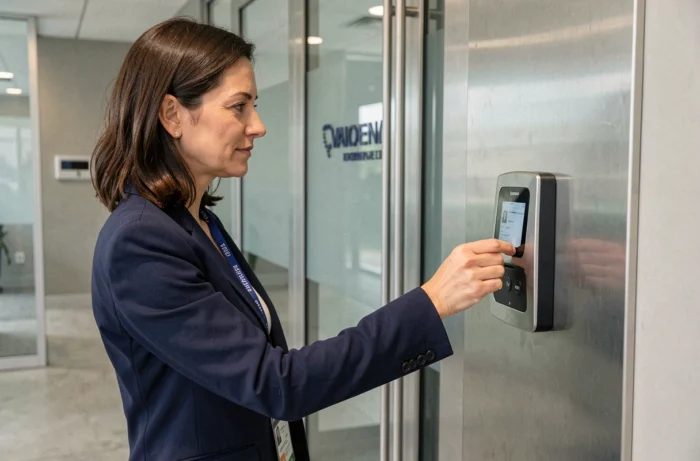
The professional access badge has become a daily reflex for millions of employees. Behind this seemingly trivial gesture lies a technical device whose ramifications touch on physical security, regulatory compliance, and convergence with digital ecosystems. Understanding how badge access control secures professional premises requires examining what happens between the presentation of the badge and the unlocking of the door.
Mobile IDs and Google Wallet: what the physical badge no longer conveys
Specialized articles extensively detail RFID, MIFARE, or magnetic badges. They overlook an ongoing transformation: the dematerialization of the access identifier into the smartphone. According to the “2024 State of Physical Access Control” report by HID Global, 39% of organizations are already using mobile identities. Contactless solutions and mobile access are at the forefront of industry trends.
In April 2024, HID announced with several partners (Smart Spaces, Cohesion) the support of professional identifiers in Google Wallet. Employees, tenants, and visitors can now store their access badge in the same digital wallet as their bank card. This convergence alters the deployment logic: instead of issuing a physical badge for each newcomer, the administrator pushes an encrypted identifier to the employee’s phone.
For managers of multi-user sites (office buildings, coworking spaces), badge access control is no longer limited to plastic support. The mobile badge reduces replacement costs in case of loss and allows for instant remote revocation without retrieving a physical object.
Zone segmentation and traceability: the true mechanism of security
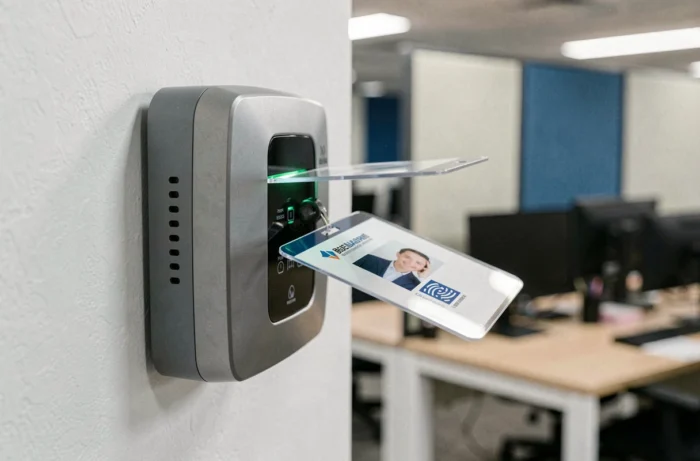
A badge does not secure a building by its mere existence. Security relies on the granularity of rights assigned to each identifier and the system’s ability to record each passage.
Access rights by profile and time slot
The central management software associates each badge (physical or mobile) with a profile: permanent employee, contractor, occasional visitor. Each profile only opens the doors corresponding to its missions, during defined hours. A maintenance technician accesses the technical room but not the server room. A visitor passes through reception but not the office floors.
This zone segmentation reduces the exposure area in case of intrusion. A stolen or cloned badge only grants access to a restricted perimeter, not the entire site.
Event logs and incident reconstruction
Each passage in front of a reader generates a timestamped line in the system: identifier, door, time, result (granted or denied). These logs serve several purposes:
- Reconstructing a path in case of theft, damage, or workplace accident, by cross-referencing data with video surveillance
- Detecting behavioral anomalies, such as repeated access attempts in an unauthorized area or passages at unusual hours
- Providing actionable evidence during an internal or judicial investigation, provided that data retention complies with legal frameworks
GDPR and CNIL constraints on badge data
Badge logs constitute personal data under GDPR, as they allow for the localization of an identified individual in time and space. This point generates concrete obligations that field feedback shows are still poorly applied in small organizations.
The CNIL strictly regulates the use of biometrics in companies (fingerprints, facial recognition). For the classic or mobile badge, requirements focus on the retention period of logs, the proportionality of the system concerning the security purpose, and prior information for employees.
An installed badge system without a processing register or employee information exposes the company to sanctions. Badge data should not be used for time tracking if that is not the declared purpose, even if the system technically allows it.
Common vulnerabilities of badge access control in companies
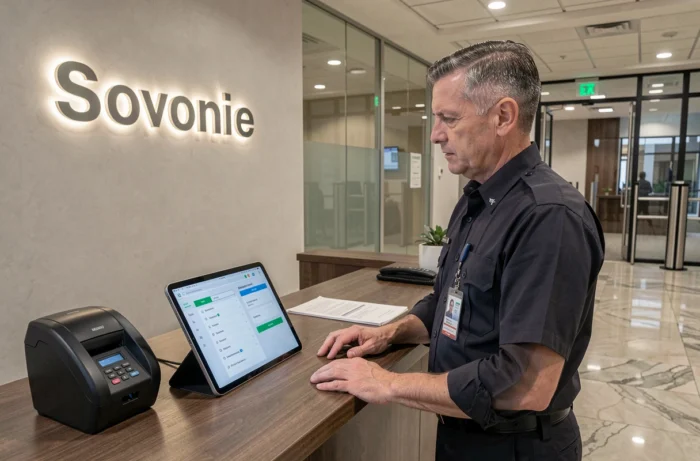
The badge, whether physical or dematerialized, only protects to the extent that human procedures follow. Several recurring vulnerabilities limit the actual effectiveness of the system.
Tailgating remains the most frequent issue: an unauthorized person follows a legitimate employee through an open door without presenting a badge. Turnstiles or anti-reverse locks reduce this risk, but their cost and bulk reserve them for main access points.
- Badges not deactivated after a departure: without an immediate deactivation procedure linked to human resources, a former employee retains functional access for days, sometimes weeks
- Doors held open for convenience (wedge, mechanical blockage), which nullifies the entire electronic control chain
- Lack of supervision of alerts: a system that records denied access attempts without anyone reviewing the logs produces no active security
The available data does not allow for precise quantification of the share of incidents related to these oversights compared to pure technological failures. Field feedback varies on this point, but most security professionals place the human factor far ahead of material failure.
Criteria for choosing between RFID, MIFARE, and mobile badges
The choice of identification technology depends on the desired level of security and the existing infrastructure. Low-frequency RFID badges (125 kHz) are the least expensive but also the easiest to duplicate. MIFARE DESFire technology, which operates at high frequency with AES encryption, offers significantly superior cloning resistance.
The mobile badge (NFC or Bluetooth) adds a layer of security related to the locking of the smartphone itself. A stolen phone protected by biometrics or a PIN is harder to exploit than a plastic badge found in a parking lot. However, the mobile badge depends on the phone’s battery and the compatibility of the installed reader.
For an existing site equipped with older readers, migrating to mobile often requires partial replacement of the reader fleet. The cost of this transition varies significantly depending on the number of access points and the existing wiring.
Securing a professional site with badges relies less on the chosen technology than on the rigor of the surrounding procedures: rapid deactivation, alert supervision, fine segmentation of rights. A technically efficient system without clear governance leaves as many gaps as a traditional key lock.