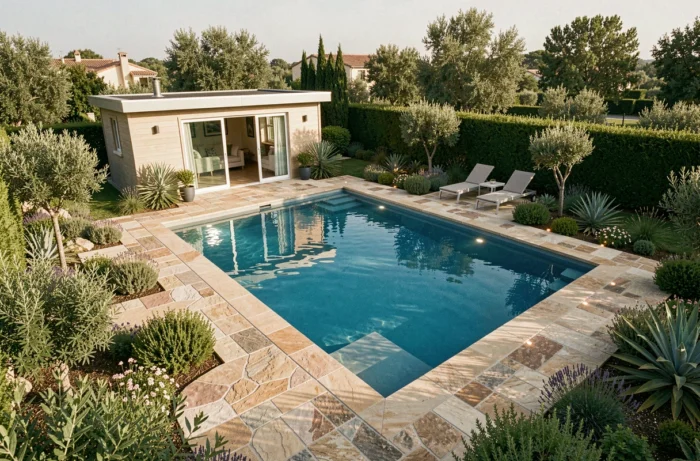
A modern outdoor pool design is no longer just about laying tiles and aligning sun loungers. Water usage restrictions related to drought decrees, safety obligations for in-ground pools, and urban planning declaration thresholds influence every design choice. Here are ten concrete ideas that take these constraints into account.
1. Natural stone submerged beach
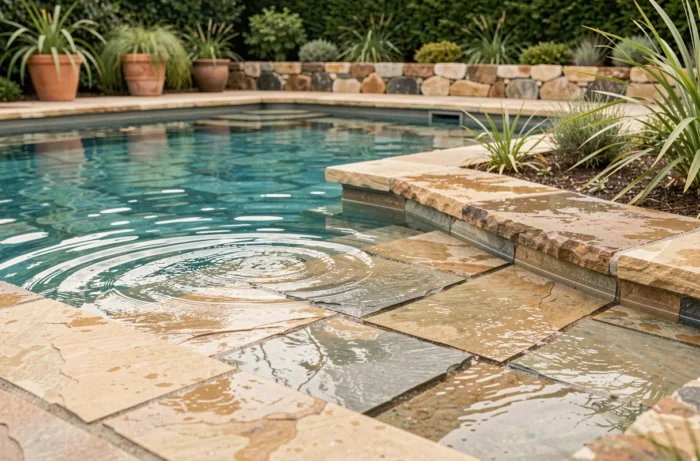
The submerged beach (or beach entry) creates a shallow water area that visually extends the terrace. Made of reconstituted stone rather than exposed aggregate concrete, the surface remains slip-resistant without additional chemical treatment.
We recommend a light-colored coating to limit thermal absorption and thus evaporation. A beige or ivory color significantly reduces the water temperature rise, which also decreases the consumption of treatment products.
2. Automated solar cover compliant with safety standards
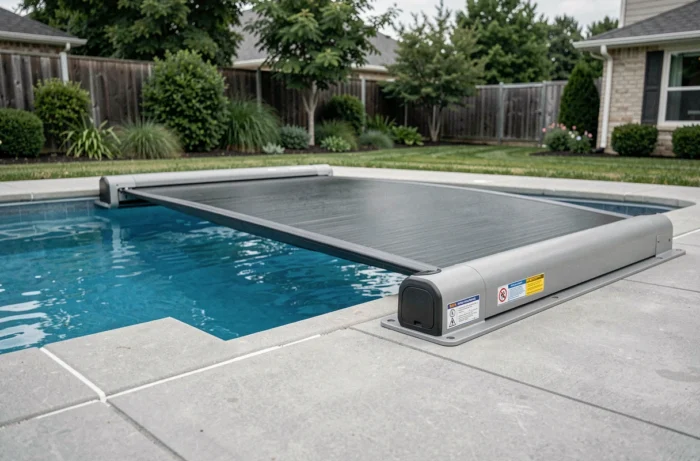
The slatted cover or submerged roller fulfills two simultaneous functions: a regulatory safety device for in-ground pools and a reduction in evaporation. French regulations require at least one of the four approved devices (barrier, alarm, cover, shelter) for any uncovered in-ground or semi-in-ground pool.
Exploring ideas for modern outdoor pool design means considering the cover from the design phase, not as an accessory added later. A solar cover integrated into the coping maintains a clean line while limiting daily water loss.
3. Low-maintenance composite wood terrace
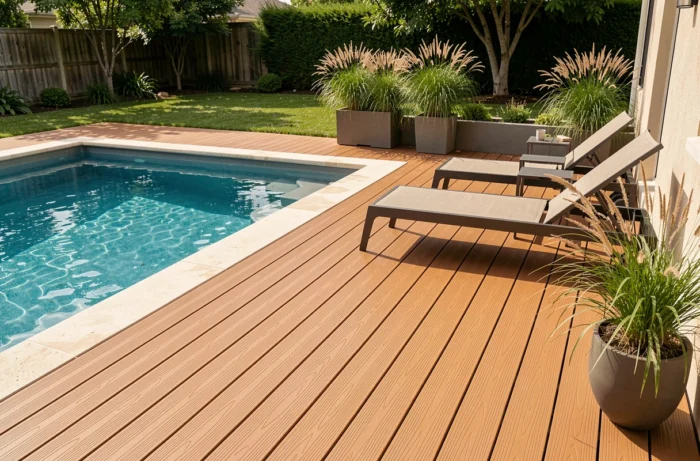
Composite wood (wood fibers and polymer resin) outperforms exotic wood in durability and maintenance. No annual staining, no splinters, and significantly higher resistance to chlorine and salt than treated pine.
The hollow profile facilitates drainage and prevents puddles at the pool’s edge. For a modern look, we prefer wide boards (over fifteen centimeters) laid in a single direction, without complex tiling.
4. Low-voltage recessed LED lighting
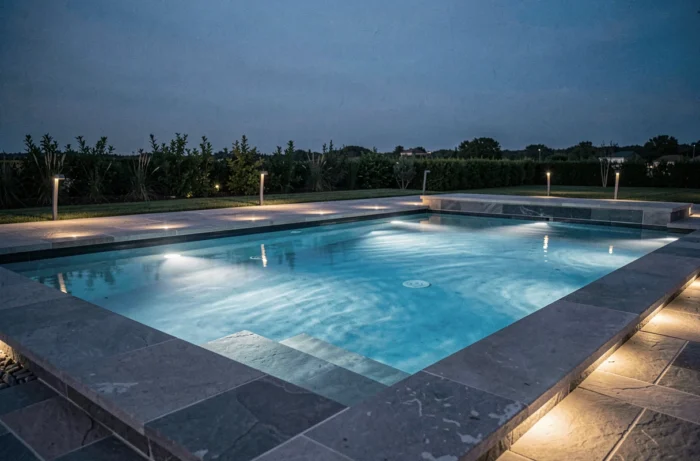
Perimeter low-voltage LED lighting (12 V) consumes a fraction of what traditional submersible halogen lights require. Recessed into the coping or in the terrace risers, it outlines the pool without glare.
Adjustable spotlights with variable temperature allow switching from warm white (relaxation) to cool white (swimming) without changing the installation. App control avoids unsightly wall-mounted boxes at the pool’s edge.
5. Mediterranean vegetation that conserves water
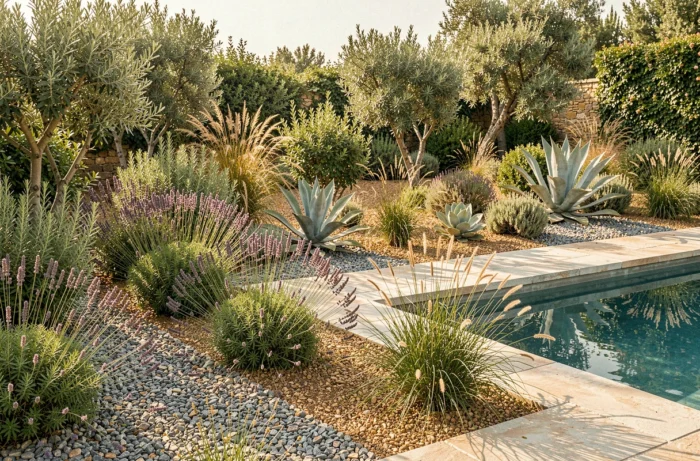
During drought periods, prefectural decrees may prohibit watering ornamental gardens. The VigiEau site allows checking the alert level community by community. Designing vegetation around the pool with xerophytic species eliminates this dependency.
Some species suitable for pool surroundings:
- Lavender, rosemary, and santolina, which tolerate chlorinated spray and do not shed leaves into the pool
- Agave and dasylirion for sculptural graphics without watering maintenance
- Grasses like Stipa tenuissima, whose fine foliage does not clog the skimmers
6. Outdoor solar shower with water recovery
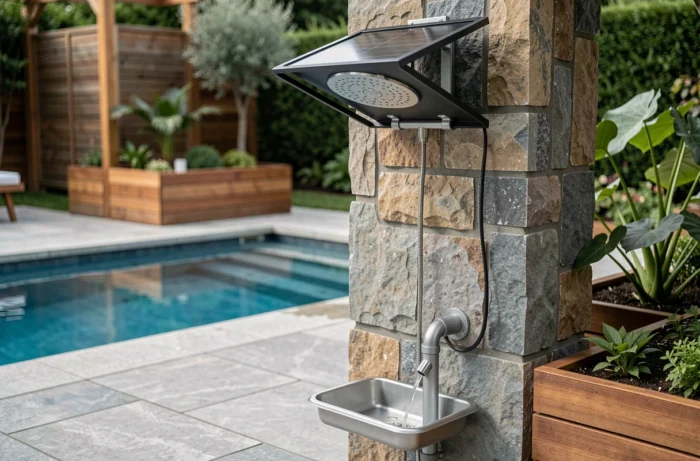
The pre-rinse shower before bathing reduces the organic load in the pool and thus the disinfectant consumption. A solar model (black tank heated by sunlight) operates without electrical connection.
Adding a recovery basin under the shower allows redirecting gray water to the plant beds in a closed circuit. This technical detail becomes an asset during water restriction periods.
7. Compact pool house with integrated technical room
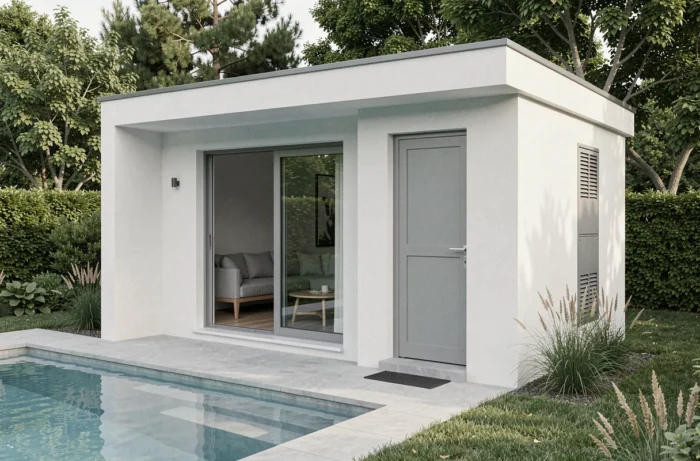
A pool house of less than five square meters of footprint generally does not require prior declaration or building permit, but this rule may vary according to the local urban planning plan. Checking the applicable thresholds for your plot remains necessary before any construction.
Integrating the technical room (pump, filter, electrical box) into the pool house avoids the difficult-to-access buried view. Outdoor storage furniture (cushions, cleaning products) completes the space without additional construction.
8. Draining mineral coating instead of grass
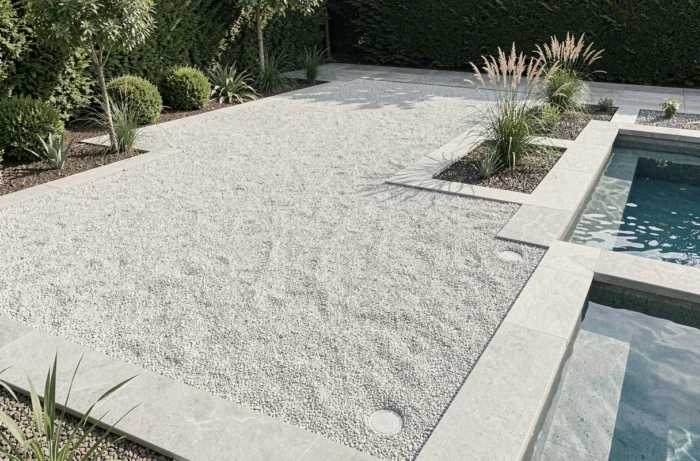
Grass around a pool poses three problems: the need for watering (prohibited during heightened drought alerts), grass blades in the skimmers, and slippery ground when wet. A coating of stabilized gravel or draining resin eliminates these three constraints.
The resin bound on marble aggregates offers a smooth and contemporary finish. Stabilized gravel on HDPE cells suits tighter budgets. In both cases, the permeability of the soil meets the requirements for managing rainwater on the plot.
9. Natural filtration system through lagooning
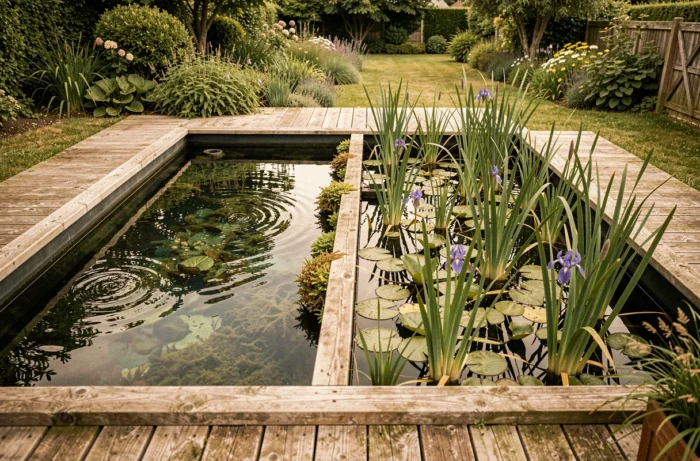
The natural pool with a vegetated lagooning area replaces chemical treatment with biological purification. The swimming basin and the filtration basin communicate through a controlled overflow or waterfall.
This system drastically reduces the consumption of chemical products and enhances the garden’s biodiversity. The trade-off: the total area required is about double that of a conventional pool, which impacts urban planning declaration thresholds (beyond ten square meters, a prior declaration is required; beyond one hundred square meters, a building permit is needed).
10. Drought design: basin adapted to water restrictions
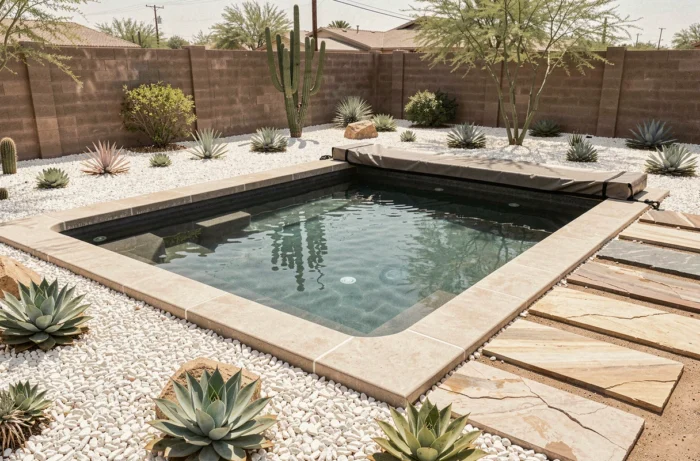
The feasibility of using a pool depends on the exact address and the current drought alert level. During heightened alert or crisis, filling and leveling may be prohibited by prefectural decree.
Three design choices reduce vulnerability to restrictions:
- Reduced volume pool (counter-current swimming rather than long length), which limits the need for leveling
- Permanent thermal cover to significantly reduce evaporation
- Recycling circuit for filter washing water to a buffer storage, reusable for topping up
The choice of a modern outdoor pool design commits for several decades. Every decision regarding materials, vegetation, or pool volume affects regulatory compliance and resilience against the recurring drought episodes that occur each year in France.