
A T1 and a T1 bis share the same administrative classification: a single housing unit with one main room. The nuance lies in an additional space (nook, mezzanine, convertible corner) that, while not constituting a closed room, alters the usable area and perceived comfort. This distinction has direct repercussions on the rent charged, rental tension, and profitability for a landlord.
Price per square meter: why smaller spaces cost more
In the French rental market, the price per square meter increases as the area decreases. A studio or a T1 of 20 m² shows a rent per square meter significantly higher than that of a T3 of 65 m². This phenomenon, documented by several real estate observatories, is explained by an unavoidable fixed cost: equipped kitchen, bathroom, connections, which weigh proportionally more on a small area.
For a tenant, moving from a strict T1 to a T1 bis often means gaining a few square meters without the overall rent rising in the same proportions. The additional cost of a T1 bis remains moderate compared to the gain in area, because the housing is still classified as a single main room. The landlord cannot justify a category jump comparable to the transition from T1 to T2.
The analysis of the difference between T1 and T1 bis on Immogenius details this pricing mechanism and its real impact on a monthly budget.
T1 vs T1 bis: comparative table of rental characteristics
| Criterion | T1 | T1 bis |
|---|---|---|
| Number of main rooms | 1 (living room/bedroom) | 1 + defined space (nook, mezzanine) |
| Kitchen | Separate from the living area | Separate from the living area |
| Usable living area | Generally less than 30 m² | Often between 25 and 35 m² |
| Separation between bedroom/living room | None | Visual or spatial, without complete partition |
| Relative rent per m² | Higher (reduced area) | Slightly lower per m² (increased area) |
| Typical tenant profile | Student, young single professional | Young professional, couple without children |
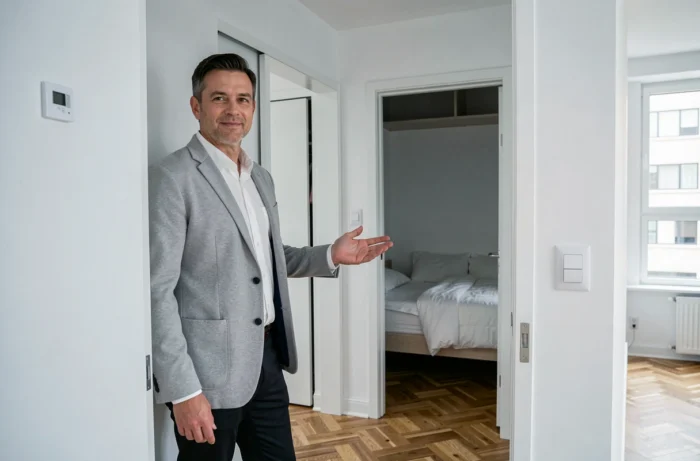
The key line in the table concerns the separation between bedroom and living room. The T1 bis offers a distinct sleeping area without complete partitioning, which differentiates it from both the T1 (no separation) and the T2 (bedroom closed by a door). This intermediate area, whether in the form of a mezzanine, nook, or recess, is sufficient to modify daily comfort without changing the legal category of the property.
Rental tension on T1 and T1 bis: a structurally unbalanced market
Small housing units are the most strained segment of the urban rental stock. According to a Bien’ici report on the first half of 2026, T1 and T2 represent about 56% of the supply but 64% of the demand at the national level. This discrepancy fuels constant pressure on rents for small spaces.
The phenomenon has worsened since 2019. An increasing share of studios and T1s has shifted from the rental market to the sales market. According to Bien’ici, the share of studios offered for rent has dropped from 47% to just 8% between 2019 and 2026. This scarcity of rental supply for very small spaces indirectly benefits the T1 bis, which attracts candidates deterred by the shortage of studios.
For tenants, this tension means increased competition for each listing. In some university towns, several dozen applications are submitted for a single studio. The T1 bis, perceived as an accessible middle ground, faces the same pressure while offering a more favorable area/rent ratio.
Concrete impact on rent: what shifts the budget
The rent of a T1 bis depends on three interacting variables:
- The usable living area calculated according to the Boutin law, which excludes areas under 1.80 m in height. A low mezzanine can inflate the perceived area without altering the legal area, keeping the rent within the range of a T1.
- The location in an area subject to rent control. In the affected cities (Paris, Lyon, Bordeaux since 2026, among others), the reference rent is set by category and area. A T1 bis remains classified as a single main room, thus subject to the same ceiling as a T1.
- The furnished or unfurnished nature of the housing. A furnished T1 bis allows for a rent supplement compared to unfurnished rentals, which can represent a significant difference on a small area.
In rent-controlled areas, the T1 bis does not allow the landlord to charge a T2 rent. The benefit for the owner lies in the attractiveness of the property (less vacancy, lower turnover) rather than a higher unit rent.
Rental profitability: T1 bis, a compromise underestimated by investors
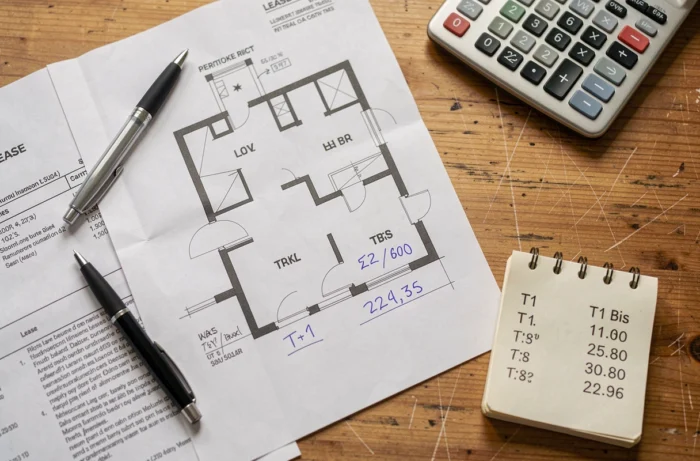
Investors often target studios to increase gross yield per square meter. The T1 bis complicates this calculation. Its slightly larger area reduces the rent per square meter, but the lower vacancy often compensates for this gap over a multi-year horizon.
A T1 bis attracts a more stable tenant profile than a studio: young professionals or couples who tend to stay longer on average. Less turnover means lower refurbishment costs, fewer periods without rent, and less administrative management. In co-ownership, the ongoing charges remain close to those of a classic T1 since the number of shares varies little for just a few square meters of difference.
With the overall rental supply remaining more than half below its 2019 level according to Bien’ici, the scarcity of small spaces supports the rents of T1 bis over time. For an owner, the T1 bis combines a rent close to that of a T1 with rental stability akin to that of a T2.
The choice between T1 and T1 bis rarely boils down to a question of definition. It is a trade-off between area, monthly rent, and duration of occupancy, in a market where every additional square meter alters the financial equation on both sides of the lease.