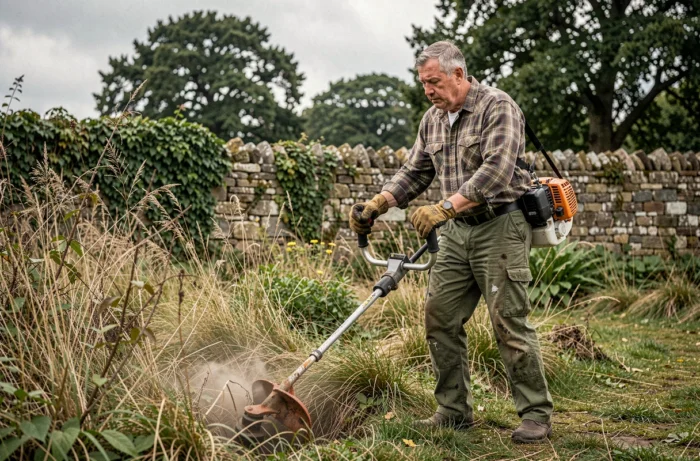
The market for petrol brushcutters remains extensive, with engine displacements ranging from under 25 cm³ to over 50 cm³ and cutting systems that vary considerably from one model to another. With so many options available, choosing the right one is about more than comparing advertised power ratings. The layout of your land, the type of vegetation and local regulations all matter just as much as the machine’s technical specifications.
Noise levels and local regulations: an often-overlooked factor
Before comparing engine displacements, check something rarely covered in buying guides: the noise regulations in your municipality. Permitted hours for using powered gardening equipment are not the same everywhere in the country. They are set by municipal or prefectural orders, and observing the permitted hours may not be enough to avoid a complaint if the noise is considered disruptive because of its duration, frequency or intensity.
In practice, a high-displacement model may be unusable in a densely populated neighborhood, even during permitted hours. Petrol brushcutters display a guaranteed sound power level on their product specifications. This provides a useful benchmark for comparing models, but does not, by itself, guarantee that they will be acceptable in every setting.
Checking with your local council before buying can help you avoid an unsuitable investment. Comparison sites such as top-debroussailleuse-thermique.com generally list noise levels in their product specifications, making it easier to narrow down your options in advance.
Petrol engine displacement: what the figures really mean
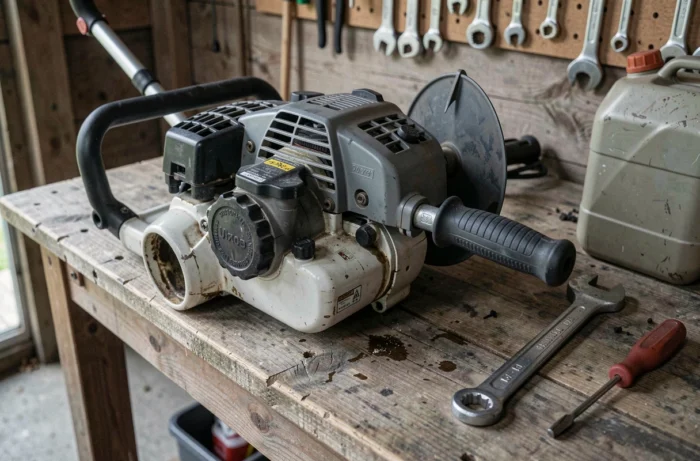
Engine displacement, measured in cubic centimeters, remains the main indicator of a petrol brushcutter’s working capacity. However, it should be interpreted differently depending on the engine type.
2-stroke or 4-stroke engine
2-stroke models dominate the market. They run on a petrol-oil mixture, offer a good power-to-weight ratio and are mechanically simpler to maintain. 4-stroke engines are less common on brushcutters; they use less fuel and produce fewer exhaust emissions. Their greater weight and higher purchase price make them better suited to users who prioritize comfort during long sessions.
Match engine displacement to the terrain
For a modest-sized garden with occasional tall grass and edges to trim, an engine displacement below 30 cm³ is sufficient. On a larger property with brambles, dense brush or steep banks, an engine displacement above 35 cm³ provides the torque reserve needed to avoid constantly straining the machine.
A common mistake is to choose an oversized model: greater engine displacement means more weight, stronger vibrations and higher noise levels. The right choice strikes a balance between the power required for the vegetation and comfort during extended use.
Cutting system: line, blade or disc depending on the vegetation
The cutting system determines what a petrol brushcutter can tackle. The three main options are not interchangeable.
- Nylon line head: suitable for soft grass, edging and working around obstacles such as trees, low walls and fences. The line wears quickly on fibrous or dry vegetation, so it needs to be replaced frequently.
- Two- or three-tooth blade: designed for tall, dense grass, young woody growth and brambles. It cuts cleanly, but requires greater care because it can kick back if it hits hidden stones or stumps.
- Tungsten or tipped disc: intended for heavy-duty work, clearing dense brush and cutting small shrubs. This type of disc withstands repeated impacts and stays sharp longer than a standard blade.
Most petrol brushcutters can be fitted with several types of cutting head. Checking compatibility and the mounting diameter before buying helps avoid finding out that a particular disc will not fit your machine.
Ergonomics and harness: fatigue as a deciding factor
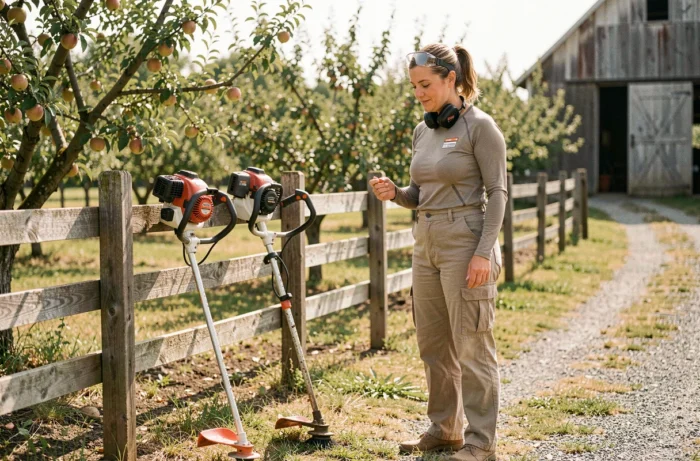
What separates machines you can use for half an hour from those you can use for an entire morning is how the weight is distributed. The harness has a much greater impact on how long you can actually work than engine power.
A simple single-shoulder strap is sufficient for a lightweight grass trimmer. For a petrol brushcutter with an engine displacement above 30 cm³, a double-shoulder harness with a waist belt redistributes the load across your torso and reduces strain on your arms and shoulders.
Professional models sometimes come with a full-body harness that distributes the weight across the entire body. This type of equipment is worthwhile for sessions lasting several hours or for working on uneven ground, where repeated swinging movements put considerable strain on your back.
Handle type
Bicycle-style handlebars provide good stability when cutting large, flat areas. Loop or D-shaped handles are better suited to steep terrain and confined spaces, where maneuverability matters more than a consistent sweeping motion.
Brush-clearing requirements: factor in your legal obligations
In areas at risk of forest and vegetation fires, clearing vegetation around homes is a legal requirement, not just a maintenance recommendation. Property owners subject to this requirement must maintain a cleared area whose boundaries are set by the regulations in force locally.
This requirement directly affects your choice of machine. A property subject to mandatory brush clearing will often require a petrol brushcutter capable of covering substantial areas in a single session, with a blade or disc suited to semi-woody vegetation. A simple line trimmer will not meet these requirements.
Checking with your local council or prefecture to see whether your property is affected will help you choose a machine with the right engine displacement and cutting system for the work required, rather than discovering after the fact that the tool you bought is underpowered.