
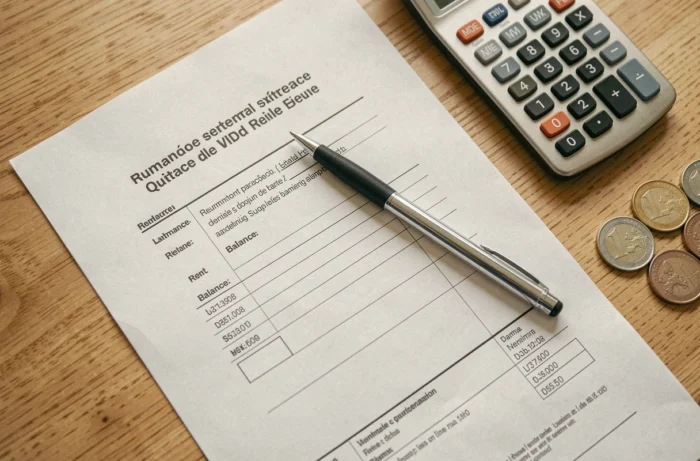
On a notice of payment or a rent receipt, the previous balance refers to the amount still owed (or overpaid) carried over from the previous period. This accounting line, often misunderstood, alters the total amount to be paid without changing either the rent or the charges for the current month. Understanding how it works avoids misunderstandings between tenant and landlord and allows for a quick check to see if there is a payment discrepancy.
Accounting mechanism of the previous balance on a notice of payment
The previous balance functions as a carryover balance. Each month, the landlord or manager calculates the difference between what the tenant was supposed to pay and what they actually paid. If the payment from the previous month was incomplete, the difference appears as a positive amount on the “previous balance” line. It is then added to the rent and charges for the following month.
Conversely, if the tenant has paid an amount greater than the total due (for example, after a charge adjustment in their favor), the previous balance appears as a negative amount or with the mention “credit.” The total amount to be paid for the current month decreases accordingly.
This line therefore does not concern either the bare rent or the provisions for charges for the current month. It is a cash balance between tenant and landlord, recalculated at each payment due date. To know precisely what the previous rent balance means in your situation, you need to compare this amount with your payment statements from previous months.

Positive or negative previous balance: concrete cases
A positive previous balance indicates a partial or total unpaid amount. Several common situations explain this.
- A late transfer or for an amount rounded down to the nearest euro: the difference, even minimal, automatically carries over to the following month.
- An annual adjustment of rental charges unfavorable to the tenant: the additional amount due is included in the previous balance of the month following the notification of the statement.
- A rejected bank transfer or a bounced check: the total unpaid rent shifts to the previous balance.
- The absence of housing assistance payment from the CAF over a given period, while the notice of payment had already taken it into account as a deduction.
A negative (or credit) previous balance appears when the tenant has overpaid. This is common after a favorable annual charge adjustment, or if the housing assistance paid to the landlord exceeds the amount deducted from the previous payment.
When the previous balance persists for several months
A positive balance that remains over two or three successive payment due dates indicates an unresolved discrepancy. This may result from a dispute over the amount due, an oversight in updating after a rent change, or a data entry error on the manager’s side. In this situation, the tenant should request a detailed account statement tracing the calls and collections month by month.
Difference between rent receipt and partial payment receipt
The rent receipt is issued only when the tenant has paid the full rent and charges for the relevant period. As long as a positive previous balance exists, the landlord cannot issue a receipt for the month when the payment was incomplete. They must then provide a receipt indicating the amount actually paid and the remaining balance due.
This distinction has direct legal implications. The receipt constitutes proof of the extinguishment of the rental debt for the specified period. A receipt, on the other hand, confirms the payment without extinguishing the obligation to pay the remaining balance. In case of a dispute, a landlord who issued a complete receipt while a balance remained would weaken their position to claim the arrears.
Requesting your receipt: the procedure to follow
When the rent and charges have been fully paid and the previous balance is zero, the landlord is obliged to provide a receipt upon simple request from the tenant. In case of refusal, the recommended course of action is to send a formal notice by registered letter with acknowledgment of receipt. This document formalizes the request and opens the way for potential recourse.
Charge adjustments and impact on the previous balance
Each year, the landlord adjusts the provisions for charges based on the actual expenses of the co-ownership or building. This adjustment statement generates either an additional amount to pay or an overpayment to be refunded to the tenant. In both cases, the amount passes through the previous balance of the next due date.
The landlord must provide a detailed statement of charges by nature (maintenance of common areas, water, collective heating, household waste removal tax) and keep the supporting documents available to the tenant for a period defined by law. The tenant who notices an unusual previous balance after receiving the statement can compare each item with the monthly provisions paid to identify the discrepancy.
- Check that the statement covers the correct period and the correct dwelling.
- Compare the total provisions paid with the total actual charges.
- Ensure that the applied share corresponds to the tantièmes or the distribution key of the lease.
A three-year limitation period governs the landlord’s ability to claim an additional charge or rent arrears. A previous balance based on an older debt can therefore be contested if this period has expired.
The previous balance is ultimately just a tracking tool: it reflects the state of the financial relationship between tenant and landlord at a given moment. Any line that seems abnormal deserves a cross-check with bank statements and charge statements, rather than an automatic payment without control.