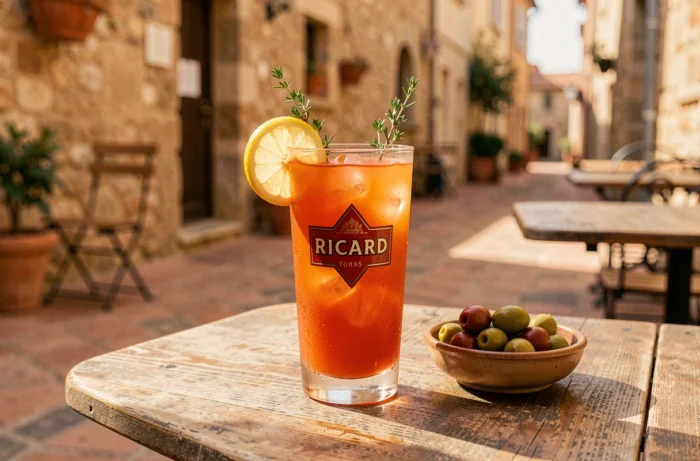
The Ricard tomato refers to a mix of Ricard pastis, fresh water, and grenadine syrup, whose pink hue resembles the color of a tomato. Despite its name, the recipe contains no tomato juice. This aperitif holds a unique place in the repertoire of French aniseed drinks, at the crossroads of Provençal tradition and a popular counter usage that has been passed down through generations.
Why Ricard pastis turns cloudy in water: the mechanism of anethole
Before discussing the tomato variant, it is essential to understand what makes pastis so special at the time of serving. Ricard is made from star anise, licorice, and Provençal herbs. These ingredients release a molecule called anethole, which is soluble in alcohol but not in water.
When fresh water is poured into the glass, anethole forms micro-droplets in suspension. This phenomenon, known as spontaneous emulsion, produces the characteristic milky cloudiness. The temperature of the water plays a direct role: the colder it is, the denser and more opaque the cloudiness.
This mechanism also explains why adding grenadine syrup to a Ricard tomato colors the mixture uniformly. The syrup disperses in the milky emulsion, giving that uniform pink hue that is impossible to achieve with a clear alcohol. The emulsion acts as a color carrier, much like a liquid foundation sets a pigment.

To delve deeper into the origin of this counter recipe, the Ricard tomato drink is the subject of a detailed account that dates back to the early decades of pastis commercialization in Marseille.
Ricard tomato and grenadine syrup: anatomy of an aperitif recipe
The preparation of Ricard tomato relies on three elements, always in the same order of service:
- A measure of Ricard pastis poured into the bottom of a tumbler, about a finger’s worth of amber liquid
- A tablespoon of grenadine syrup, added directly into the pastis before the water, so that the sugar mixes with the concentrated alcohol
- Very cold water, poured slowly in a stream to provoke the emulsion and achieve the uniform pink color
The water/pastis ratio varies according to habits, but most counter usages revolve around five parts water to one part pastis. The grenadine syrup adds sweetness that softens the bitterness of the licorice and mellows the dominant anise note.
The name “tomato” comes solely from the color of the mixture, not from any tomato-based ingredient. This confusion persists among many consumers who discover the recipe for the first time.
From the Marseille counter to vegetable cocktails: Ricard tomato as an ancestor
Tomato as a cocktail ingredient has seen a resurgence of interest since the 2010s, in a logic of vegetal, saline, and tangy flavors that contrasts with very sweet aperitifs. The Tomatini, created in 2010 by bartender Jimmy Barrat at La Petite Maison (LPM) in Dubai, has become an international signature cocktail widely featured in the specialized press.
This movement inadvertently repositions Ricard tomato as a popular precursor. While contemporary cocktails use fresh tomato juice, clarified tomato waters, or gazpachos, Ricard tomato was already playing on the idea of an aperitif evoking the vegetal through its color and name, even if the recipe remained purely aniseed and sweet.
The fundamental difference lies in the taste profile. Modern tomato-based cocktails seek umami and acidity. Ricard tomato, on the other hand, remains anchored in the realm of anise and sugar, with grenadine as the only flavor modulator. This discrepancy between the name and the content is part of its popular charm.
Pernod and Ricard: two pastis, two approaches to aniseed aperitif
The rivalry between Pernod and Ricard has shaped the market for aniseed drinks in France for decades. Paul Ricard launched his pastis in 1932, following the ban on absinthe in 1915, which had left a void in consumption habits. He adopted the slogan “Ricard, the true pastis of Marseille” to anchor his product in Provençal identity.
Pernod, heir to an older tradition linked to absinthe, offered an anise with a different aromatic profile. The two brands eventually merged within the Pernod Ricard group, but the recipes remain distinct and regional preferences persist.
Ricard tomato developed as a popular variant primarily in the south of France. Marseille café owners often offered a row of syrups on the counter (grenadine, orgeat, mint), and each combination had a name:
- Ricard + grenadine syrup = tomato
- Ricard + mint syrup = parrot
- Ricard + orgeat syrup = mauresque
These three variants form the classic trio of aniseed aperitif as it is still practiced in bars and brasseries in the south. Each modifies the color and basic flavor of pastis without altering its aniseed structure.

Ricard tomato remains an aperitif whose recipe has not changed since its informal creation at Provençal counters. Its misleading name, distinctive color, and simplicity of preparation ensure its longevity that more elaborate cocktails struggle to match. The grenadine syrup, a splash of sugar in a glass of troubled anise, is enough to transform a pastis into an object of curiosity for anyone ordering it for the first time.