
Between neighbors who park two-wheelers on the sidewalk and residents convinced that the concrete strip in front of their house belongs to them, the subdivision concentrates a good portion of disputes related to parking. Understanding who is competent to regulate what requires distinguishing the status of the roadway, the role of the subdivision regulations, and the powers of the mayor, three normative layers that overlap without always coordinating.
Public roadway, private roadway, and common areas: the legal status that determines everything
The first question to resolve is not “do I have the right to park here?”, but “who owns this road?”. The answer conditions the applicable sanction, the competent authority, and the possible remedies.
| Criteria | Public roadway (transferred to the municipality) | Private roadway (common areas of the subdivision) |
|---|---|---|
| Owner | Municipality | Free trade union association (ASL) or co-owners |
| Applicable text for parking on the sidewalk | Highway Code (article R417-11) | Subdivision regulations + specifications |
| Authority for sanction | Municipal or national police | Civil judge (neighborhood disturbance) |
| Direct ticketing possible | Yes | No (unless the roadway is open to public traffic) |
| Recourse for the disturbed resident | Report to the mayor, contest fine in police court | Formal notice via the ASL, then civil action |
When a subdivision is new, the roadway often remains private for several years before a possible transfer. During this period, the Highway Code only applies if the road is open to public traffic. A “private property” sign or a barrier may suffice to exclude the intervention of the municipal police.
To delve deeper into the parking rules on sidewalks in a subdivision, one must first check the sales deed or the specifications of the subdivision to identify the exact status of the roadway.
Subdivision regulations and specifications: two texts, two scopes
Many residents confuse these two documents. The subdivision regulations set urban planning rules (location, height, external appearance). It becomes obsolete after ten years if the subdivision is covered by a local urban plan (PLU).
The specifications, on the other hand, are a contractual document between co-owners. Its lifespan is not limited by the Urban Planning Code. This text generally contains clauses related to parking: obligation to park on one’s own lot, prohibition of occupying common spaces, restrictions on parking caravans or utility vehicles.
- The specifications apply to all successive owners, even if they were not aware of them at the time of purchase, as long as they have been published with the land publicity service.
- Its violation does not fall under criminal law but civil law: a co-owner must take the matter to the judicial court to stop the disturbance, which involves costs and delays.
- Some specifications provide for contractual penalties in case of repeated violations, but their application remains rare due to a lack of active management by the ASL.
However, if the roadway has been transferred to the municipality, the specifications cannot authorize what the Highway Code prohibits. A co-owner cannot invoke a tolerance from the subdivision to park on a municipal sidewalk.
Fire access and turning areas: the forgotten constraint of recent subdivisions
Urban planning documents impose turning areas and sufficient roadway widths for emergency vehicles, particularly at the end of cul-de-sacs. This requirement, systematic in recent subdivisions, has a direct effect on parking.
A vehicle parked on the sidewalk of a cul-de-sac can block access for a fire truck. This situation legally establishes a strict prohibition on parking, even in the absence of a sign. The mayor has the power of general police to issue an order prohibiting parking in these maneuvering areas.
Several municipalities are now extending their municipal orders beyond the city center, towards the access roads of subdivisions. This trend is reflected in recent roadway orders from suburban municipalities, which explicitly target cul-de-sac streets and turning areas of subdivisions.
Absence of sign and ticketing
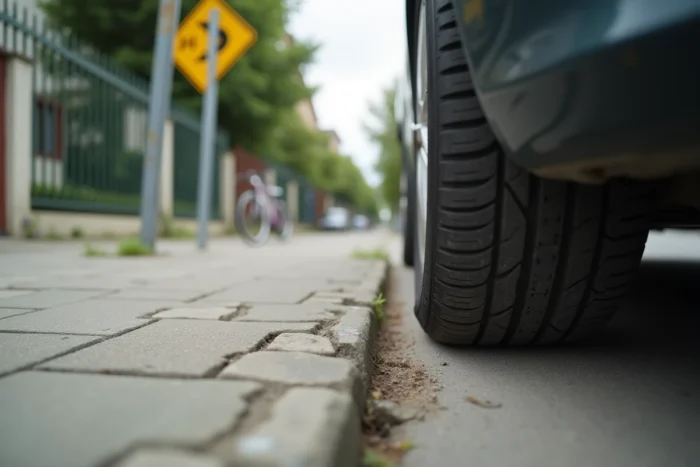
Article R417-11 of the Highway Code generally prohibits parking on sidewalks. No sign is necessary for the prohibition to apply. Signage serves to remind the rule, not to create it. A motorist ticketed cannot contest the fine on the grounds that no prohibition sign was visible.
Conversely, the mayor can authorize parking on sidewalks by municipal order, provided that a pedestrian passage is kept clear. This type of exemption remains targeted and requires a reasoned deliberation.
Concrete remedies against abusive parking in subdivisions
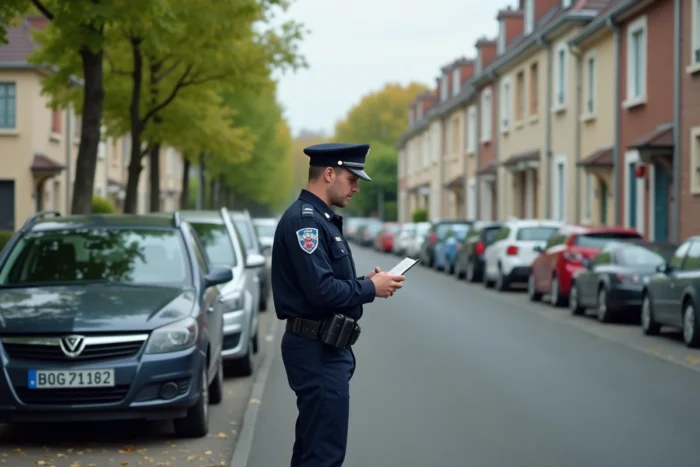
The practical response depends on the status of the roadway. On a public road, reporting to the mayor or municipal police can trigger ticketing. On a private road, the process is longer.
- Send a formal notice to the offender by registered letter, citing the violated clause of the specifications.
- Contact the ASL to enforce the regulations, if it exists and functions (which is not always the case).
- In case of inaction by the mayor on a public road, an administrative appeal against the refusal to act is possible before the administrative court, invoking the failure of police powers.
- As a last resort, take the civil judge for abnormal neighborhood disturbance, documenting the nuisance (photos, bailiff reports, testimonies).
The case of subdivisions where the mayor refuses to intervene illustrates the difficulty: as long as the roadway remains private, the municipality has no obligation for maintenance or traffic policing. Residents then find themselves alone facing a conflict that neither criminal law nor administrative law directly addresses.
Parking on sidewalks in subdivisions is rarely resolved by a single action. The overlap between urban planning law, contractual civil law, and the Highway Code creates gray areas that only the exact qualification of the roadway can clarify. Checking the specifications and the status of the roadway transfer remains the first useful reflex before any other action.