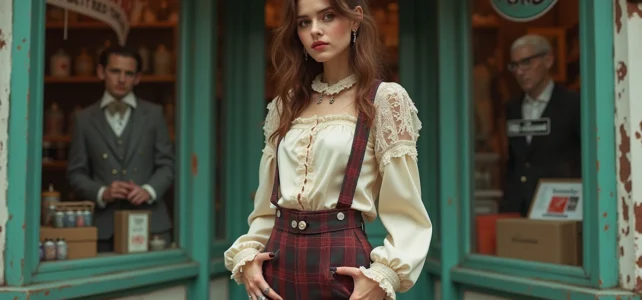
Wearing studded pants to the office, pairing a vintage military jacket with a pleated skirt for a wedding, adapting a gothic look to the heat of July: alternative fashion faces real-life situations that generic guides do not address. Building a unique style requires less abstract inspiration than practical methods for selecting, combining, and maintaining standout pieces without ending up at the back of the closet.
Everyday alternative fashion: adapting pieces to real constraints
We often start by accumulating bold clothing (studded leather jacket, black lace dress, skull-patterned shirt) without considering their weekly rotation. The first useful reflex is to check that each alternative piece works with at least three neutral bottoms or tops already present in the wardrobe.
A Victorian dress worn once a year is not a style investment; it’s a costume. In contrast, a bold piece worn every week becomes a signature. A biker jacket, well-cut ripped jeans, or a recurring accessory (statement ring, eyelet belt) anchors the alternative look in reality.
Opinions vary on this point, but pairing a single statement piece with a sober outfit often creates more impact than a total alternative look. Effective combinations are regularly discovered on the fashion section of L’Actu Dissidente, where the proposed looks mix styles and eras without falling into caricature.
For professional environments with a dress code, the most reliable strategy remains to focus the alternative on accessories and cuts rather than prints. Buckled boots, an enamel brooch, bold eye makeup: these elements pass where a metal band t-shirt does not.
Second-hand and upcycling: concrete pathways to a unique look
Buying new in an alternative niche is expensive. A handmade steampunk jacket or a custom-made corset represents a budget that most people cannot renew every season. Second-hand and upcycling change the equation.
Second-hand: going beyond general thrift stores
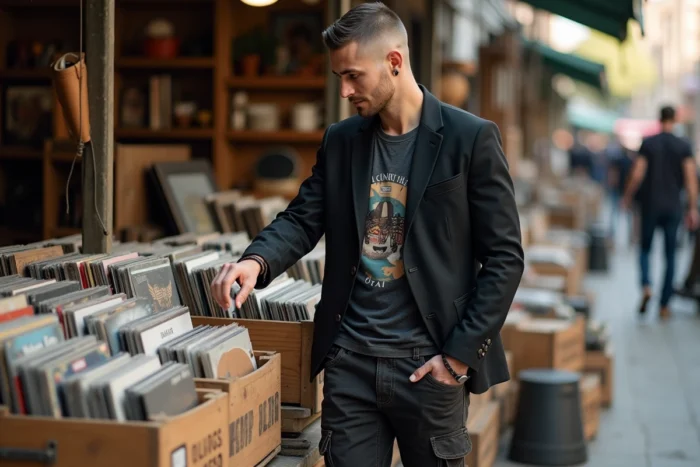
Classic thrift stores mainly offer mainstream vintage. To find truly alternative pieces, time is saved by targeting specialized wardrobe sales (goth events, punk conventions, local designer markets) and resale platforms where subculture filters exist.
Checking the condition of seams, closures, and eyelets before buying avoids disappointments. Deep cracks on vintage leather cannot be repaired with a simple polish. A torn lining, however, can be easily replaced by a tailor for a few euros.
Upcycling: transforming without advanced sewing skills
The global market for upcycled fashion is experiencing significant growth, estimated at $9.78 billion by 2026 according to Fortune Business Insights. This trend goes beyond simple DIY: workshops now offer sessions where participants learn to combine several reclaimed fabrics into one piece, following a mix-match aesthetic that perfectly aligns with alternative fashion.
Some accessible transformations without an industrial sewing machine:
- Cutting straight jeans into tapered shorts and adding iron-on patches or safety pins for an immediate punk look
- Dyeing a light garment deep black with a cold dye bath, transforming a bland basic into a usable piece
- Recovering chains, buckles, or buttons from damaged clothing to attach to a jacket or bag in good condition
Upcycling produces pieces that no brand offers in the same way, which instantly resolves the issue of originality.
Anti-fast fashion law and alternative fashion: what changes for buyers
The French law known as “anti-fast fashion,” adopted in 2024, alters the landscape for all fashion consumers, including those who buy alternative. Two measures have a direct impact.
The first concerns the prohibition of advertising for actors identified as ultra-fast fashion, including through influencers. Specifically, certain low-cost brands that offered “gothic” or “punk” ranges at rock-bottom prices lose their visibility on social media. This reduces the temptation to buy poorly made pieces that degrade after two washes.
The second measure provides for a financial penalty system that can reach 50% of the product’s price. The Senate report (n°765, 2025-2026) specifies a range of €0.25 to €6 per item in 2026, and €2 to €10 starting in 2030. For ethical alternative brands that produce in small batches with sustainable materials, this penalty does not apply or remains minimal. The price gap between fast fashion and alternative fashion is therefore mechanically reduced.
Building a sustainable alternative wardrobe: the capsule method
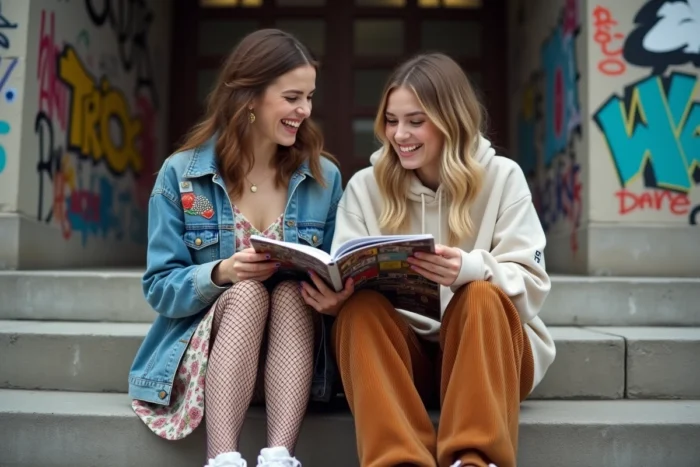
Rather than accumulating pieces over time based on whims, one can structure their alternative wardrobe into thematic capsules. Each capsule groups five to eight pieces that work together and cover a typical week.
A concrete example for a punk-rock style adapted to daily life:
- Two pairs of jeans (one black slim, one raw ripped at the knees) that serve as interchangeable bases
- A leather or faux leather biker jacket and a customized denim jacket with pins and patches
- Three tops (a band t-shirt, a solid tank top, a plaid shirt) that rotate according to the context
- A pair of lace-up boots and a pair of high-top sneakers with thick soles
Five to eight well-chosen pieces generate more combinations than an overloaded closet. It also avoids monotony: each piece is worn often enough to justify its purchase, but the rotation remains sufficient to vary the looks.
The first purchase to prioritize is the jacket. It is the most visible piece in an outfit, defining the style before one even looks at the rest. A good biker jacket or an oversized corduroy blazer directs the entire wardrobe. Tops and accessories then gradually complete the capsule, at the pace of second-hand or upcycling finds.
Alternative fashion does not require a huge budget or an overflowing wardrobe. It demands clear choices, pieces that withstand use, and the ability to combine styles without following seasonal dictates. The anti-fast fashion penalty that is being implemented and the rise of upcycling reinforce this logic: betting on fewer, better-made pieces that are worn longer.