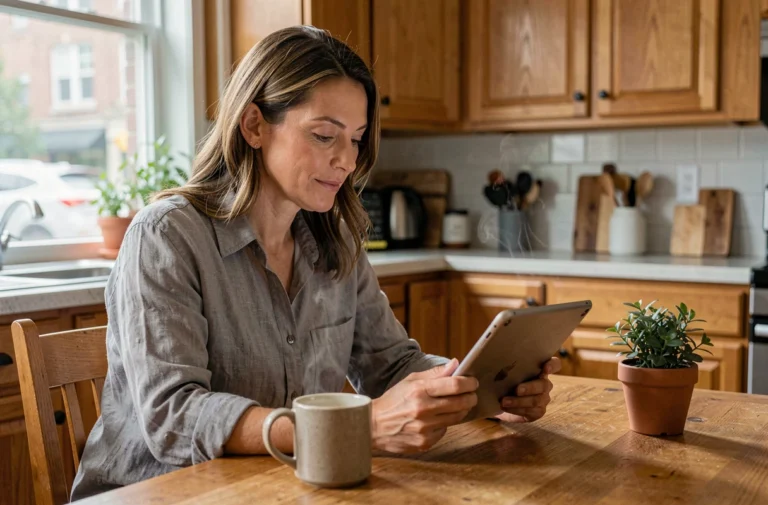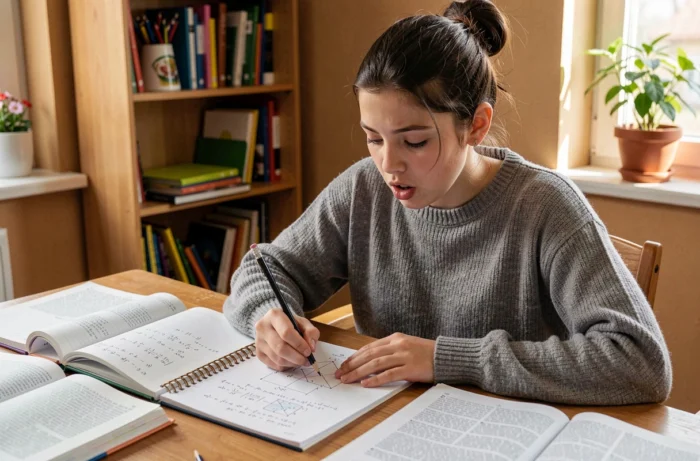
Improving in math relies less on innate talent than on measurable work habits. Research in cognitive science identifies concrete levers to enhance performance. This article reviews ten actionable techniques, from spaced repetition to structured use of AI, to improve math results and succeed in assignments.
1. Targeted spaced repetition on isolated procedures
A meta-analysis published in 2025 in Educational Psychology Review shows that spaced repetition is especially effective for isolated skills: formulas, factoring rules, notable identities. For multi-step problems, spacing alone is not sufficient.
Specifically, this means planning reviews of formulas and definitions at increasing intervals (one day, three days, one week) using paper or digital flashcards. Reserve longer sessions for complex exercises, addressed with other methods.
To delve deeper into this tiered work logic, math tips on Blog Famille detail complementary strategies tailored for middle and high school students.
2. Alternating types of exercises in the same session
Working on twenty identical exercises on quadratic equations gives an illusion of mastery. Cognitive research recommends interleaving: mixing geometry, algebra, and probability exercises in the same session.
This alternation forces the brain to identify which tool to mobilize before solving, closely resembling the real conditions of a test. The gain is significant in the ability to transfer a method from one chapter to another.
3. Active recall before rereading the lesson
Rereading notes three times creates a sense of familiarity, not solid understanding. Active recall involves closing the notebook and trying to reproduce the theorem, proof, or solving method from memory.
Writing down what you remember before checking allows you to pinpoint unclear areas. This technique, combined with spaced repetition, targets gaps instead of skimming over what you already know.
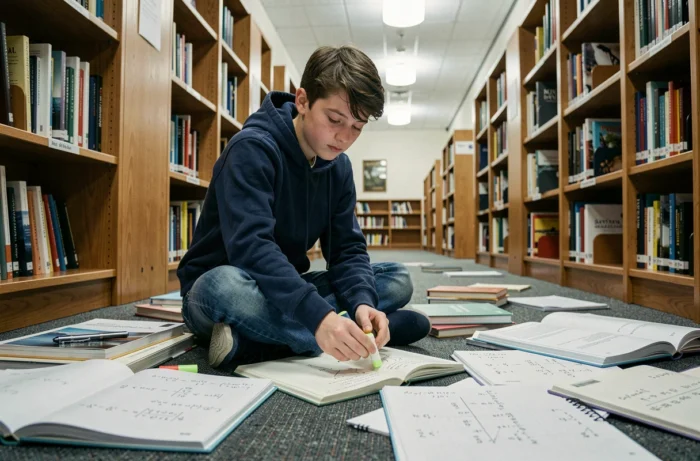
4. Diagnostic feedback rather than binary correction
A synthesis published in Frontiers in Education in 2026 indicates that AI tutoring systems are more useful when they provide diagnostic feedback related to mathematical reasoning, rather than a simple “true/false.” Immediate feedback can even reduce the effort to search for solutions and foster dependency on the tool.
When correcting an assignment yourself, the best practice is to write in the margins why the mistake occurred: confusion between two properties, sign error, misreading the statement. This diagnosis guides the next review session.
5. French regulatory framework for AI and assignments
Since June 2025, a national framework published by the Ministry of National Education prohibits students from directly manipulating generative AIs before the seventh grade. From seventh grade onwards, usage may be allowed under teacher supervision. In high school, more autonomous use remains conditioned on a defined educational framework.
Using AI to obtain the solution to an exercise without understanding the reasoning contradicts the learning objective. Students who benefit from these tools use them to verify a process after attempting it, not to replace it.
6. Keeping a structured error notebook
Learning from mistakes is common advice. Making it actionable requires a physical support: a dedicated notebook where each error is categorized by type.
- Calculation errors: forgotten sign, misapplied distributive property, improperly simplified fraction. These errors can be corrected through targeted mental calculation exercises.
- Method errors: wrong choice of theorem, forgetting an application condition. They require revisiting the corresponding lesson.
- Statement reading errors: ignored data, misinterpreted question. Training to rephrase the statement in one’s own words reduces these errors.
Reviewing this notebook before a test allows focusing on recurring weaknesses rather than uniformly revising.
7. Pair work with mutual explanation
Explaining a concept to a peer is one of the most reliable tests of one’s own understanding. If the explanation falters, it indicates incomplete mastery.
Pair work works best when each person prepares a different exercise and then explains their solution to the other. This format avoids the trap of a group where one student does the work while others copy.
8. Short and regular sessions rather than marathons before the test
Twenty minutes of math daily is better than three hours the night before an assignment. Regularity consolidates long-term memory, while intensive cramming produces fragile results that collapse within days.
A realistic weekly schedule spreads math work over four to five days, varying activities: reviewing lessons one day, application exercises the next, synthesis problems at the end of the week.
9. Reformulating the statement before any resolution
Many math errors do not stem from calculation flaws but from a poor understanding of the question posed. Before performing any operation, reformulating the statement in your own words, identifying the data and the sought quantity radically changes the success rate.
Highlighting numerical data and circling the question is a simple habit that enforces active reading. In a geometry problem, an annotated diagram serves the same function.
10. Targeted use of videos and online resources
Math course videos are abundant. Their effectiveness depends on how they are used.
| Usage | Effect on progress |
|---|---|
| Passively watching a course video | Low: illusion of understanding, limited retention |
| Pausing, attempting the exercise, then resuming | High: engages active recall and verification |
| Watching the solution before trying | Counterproductive: eliminates the effort to search |
The video is a supplement, not a substitute. It serves to unlock a specific point after struggling with it, not to replace reading the lesson or practicing exercises.
Progress in math is measured over weeks, not on a single revision evening. Among these ten levers, the combination of active recall, spacing, and error notebook produces the most documented results according to recent research. The rest is a matter of consistency.