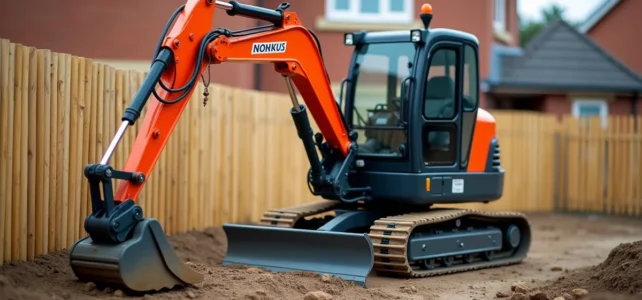
Width of the chassis, transport height, swing radius: the dimensions of a mini excavator directly determine the sites it can access and the work it can perform. Comparing these measurements before choosing a model helps avoid unpleasant surprises, whether it’s passing through a garden gate or loading the machine onto a trailer.
Width, height, radius: dimensions that vary by tonnage
Tonnage remains the primary selection filter, but two mini excavators of similar weight can have very different dimensions. The table below summarizes the order of magnitude by weight class, as found in the specifications of common manufacturers.
| Weight Class | Indicative Chassis Width | Indicative Transport Height | Indicative Digging Depth |
|---|---|---|---|
| Less than 1.5 t | About 70-100 cm | About 220-240 cm | About 150-180 cm |
| 1.5 t to 3 t | About 130-150 cm | About 240-250 cm | About 220-280 cm |
| 3 t to 6 t | About 170-200 cm | About 250-270 cm | About 300-400 cm |
The chassis width determines access to the site. The transport height affects clearance under a porch or low bridge. The digging depth sets the actual excavation or grading capacity.
Before focusing on weight, it’s better to physically measure the narrowest passage on the site and the most restrictive free height. An article detailing what dimensions for a mini excavator allows you to compare these measurements with the dimensions available on the market.
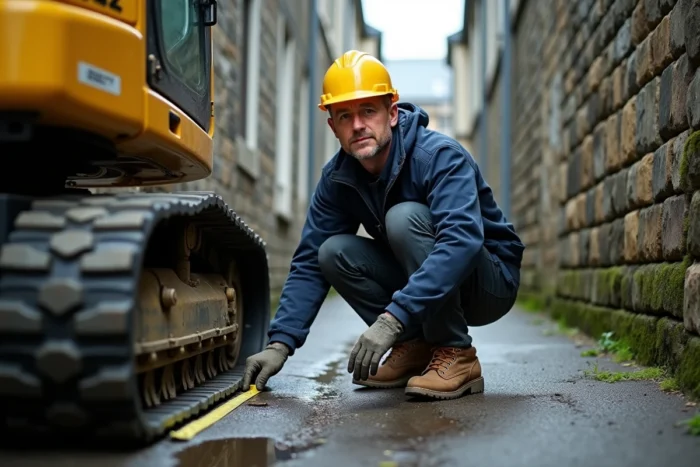
Variable-width mini excavator: a chassis that adapts to narrow access
Selection guides often discuss tonnage and digging depth, but rarely the mechanism of variable width on the chassis. This system allows for widening or narrowing the track spacing without disassembling anything.
On models in the 1 to 1.3-ton class, the retracted width can drop to around 70 to 80 cm. When deployed, it provides a more stable base for digging or lifting a load. This type of chassis is offered by several manufacturers, including Eurocomach with the ES 300 SR, marketed as suitable for difficult access, confined spaces, and indoor work.
The variable width changes the selection logic. Instead of selecting a model solely based on its weight, one can choose a slightly heavier machine, thus more efficient in digging depth, while still maintaining a reduced passage size thanks to the retraction of the tracks.
When variable width makes a difference
- Passing through a standard residential gate (clear width often less than one meter) without disassembling a post or widening the opening.
- Indoor building work (renovation, partial demolition) where the mini excavator must pass through a door or navigate a hallway.
- Urban infill sites, where the route between the unloading area and the work zone goes through a pedestrian alley or a passage between two walls.
However, a variable width adds an additional hydraulic mechanism. This requires regular maintenance of the retraction cylinders and a slightly higher acquisition or rental cost compared to an equivalent fixed chassis.
Transport constraints and height of the mini excavator
Transport height is the most often overlooked dimension when making a choice. A mini excavator weighing 3 to 6 tons, with the arm folded, frequently exceeds 2.50 m. Loaded onto a flatbed trailer, the total height easily reaches 3 m or more, which can be problematic under certain bridges, in underground parking lots, or on routes with limited dimensions.
For machines under 1.5 tons, the height is around 2.20 to 2.40 m. They can be transported on a light trailer towed by a utility vehicle without exceeding common road dimensions. This vertical compactness explains their popularity for rental among individuals and landscapers.
Weight and transport regulations
The weight of the mini excavator plus that of the trailer determines the necessary license and the type of towing vehicle. A machine under 1.5 tons on an appropriate trailer often remains within the limits of a category B license with trailer training (BE). Beyond that, a heavy vehicle license or transport by low-loader becomes necessary.
Checking the payload of the trailer before choosing the mini excavator helps avoid being overloaded. The dimensions are not limited to width and height: the total authorized weight of the towing vehicle must also be considered.
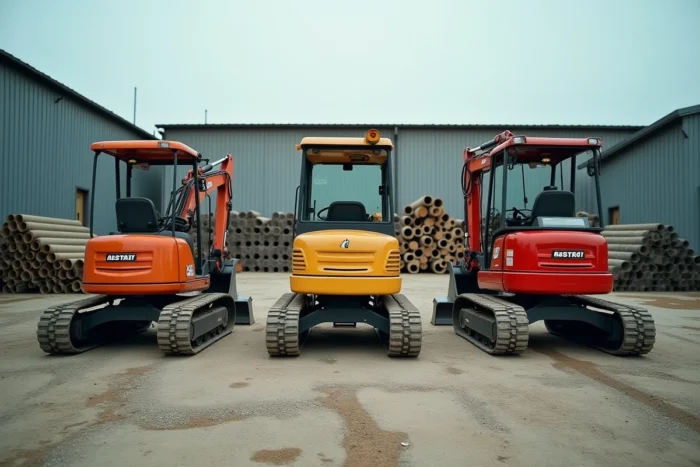
Impact of Low Emission Zones on the choice of a mini excavator
Low Emission Zones (LEZ) are multiplying in French urban areas. They primarily concern road vehicles, but regulatory pressure is gradually extending to non-road construction equipment. Several manufacturers, including Manitou, are promoting electric ranges intended for construction sites in city centers subject to LEZ restrictions.
An electric mini excavator generally has dimensions comparable to its thermal equivalent, sometimes slightly more compact due to the absence of a bulky diesel engine block. The weight of the batteries partially offsets this gain, but the external dimensions remain similar.
For a construction site in a dense urban area, the choice between thermal and electric does not change the dimensions to check (width, height, swing radius). It adds an additional constraint: battery autonomy and access to a charging outlet on site.
Digging depth and bucket dimensions
The digging depth stated by the manufacturer corresponds to the maximum reach of the arm in a vertical position. It varies according to the length of the boom and the kinematics of the arm, not just by tonnage.
The bucket, on the other hand, comes in several widths. A narrow bucket (about 30 cm) is suitable for digging trenches for networks. A wide grading bucket (60 cm and more) moves more soil with each cycle but requires a machine with enough hydraulic power to fill and lift it.
- For pipeline trenches, a narrow bucket on a machine of 1.5 to 3 tons offers a good compromise between precision and depth.
- For surface grading (excavation, leveling), a wide bucket on a machine of 3 tons or more speeds up the work.
- For finishing work in landscaping, a flat cleanup bucket allows for leveling the bottom of the excavation without over-digging.
The width of the bucket does not affect the transport dimensions of the machine, but it changes the working footprint on the ground. On a narrow site, a bucket that is too wide forces the operator to make multiple turret rotation maneuvers, which slows down the job and increases the risk of hitting an obstacle.
The choice of dimensions for a mini excavator rarely comes down to just tonnage. Chassis width, transport height, digging depth, and bucket size form a set of dimensions to be cross-checked with the physical constraints of the site. Measuring the terrain before consulting the technical specifications remains the most reliable method to avoid a machine that is too wide or too tall getting stuck at the entrance of the site.