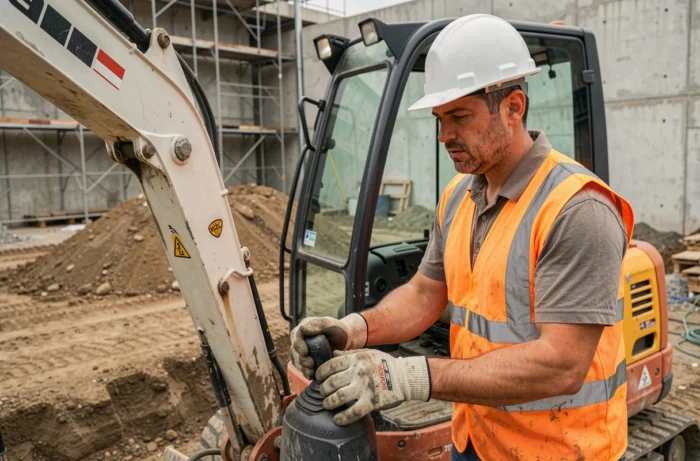
On a renovation site or for finishing work, the equipment used sometimes only serves for a few hours. A wall groove cutter for running conduits, a thermal drill for facade fixings, a floor cutter for a connection: these are all pieces of equipment whose purchase cost is hard to justify against occasional use. Renting equipment by the day addresses this gap between the actual need on site and the amortization period of a tool.
Driving authorization and short-term rental: what has changed in 2025
The regulations governing construction machinery have recently evolved, and this change directly affects daily rental practices. Since October 1, 2025, the driving authorization in France is based on a medical certificate valid for five years, replacing the old fitness certificate. The documentation requirements have tightened for machines subject to authorization.
The list of affected equipment has also been clarified, with an explicit distinction between families subject to authorization and those that are not. For a contractor renting a mini-excavator or a lift by the day, this distinction changes the site preparation: it is necessary to check in advance whether the operator has the up-to-date document, or risk a delay on the day of delivery.
When renting equipment from travauxsuccess, choosing equipment by category allows for anticipating these regulatory constraints before confirming the reservation.
This regulatory point remains underestimated. Many professionals discover the requirement at the time of pickup, which negates the expected time savings from short-term rental.
Rental with or without operator: two distinct legal frameworks on site
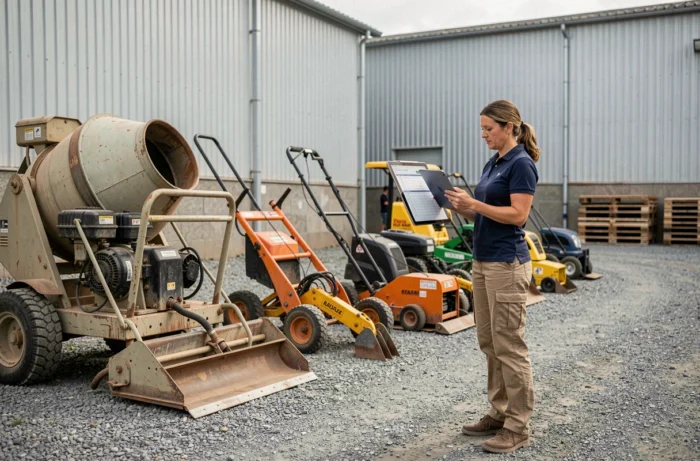
Renting a machine for the day does not cover the same reality depending on whether or not an operator is included with the machine. Rental with an operator falls under a service provision, linked to a different activity code than dry rental (without an operator). The obligations of the lessor and the client on site are not the same.
In dry rental, the tenant assumes responsibility for use, site safety, and compliance with driving authorization rules. In rental with an operator, it is the provider who bears part of these obligations. This sharing has implications for insurance and liability in case of an incident.
For a daily rental, the choice between these two options depends on the type of work and the internal skills available. On a one-off earthworks site, bringing in a qualified operator with the machine can significantly reduce intervention time, even if the daily cost is higher.
Equipment fleet management: when daily rental replaces storage
Purchasing construction equipment requires storage space, maintenance tracking, periodic checks, and administrative management (safety register, periodic general inspections). For a small construction company, these indirect costs weigh as much as the initial purchase price.
Daily rental eliminates these expense items. The equipment arrives checked, maintained, and compliant with current standards. The tenant does not manage maintenance or storage between two jobs.
Field feedback varies on this point depending on usage frequency. A contractor who uses specific equipment more than two or three times a month may reach a threshold where cumulative rental exceeds acquisition cost. The decision rests on a few concrete criteria:
- The actual usage frequency over the last six months, not the estimated frequency at the time of purchase
- The cost of storage and insurance for owned equipment, often overlooked in calculations
- The availability of a recent model for rent, compared to aging owned equipment that requires repairs
- The administrative time related to mandatory checks and documentation tracking for each machine
Actual usage duration on site: the trap of the daily rate
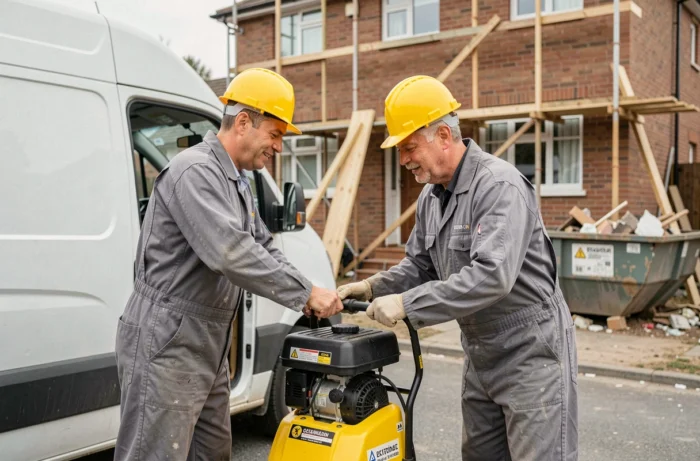
A day of rental does not always correspond to a productive workday. Between pickup at the agency (or delivery on site), commissioning, actual use, and return, the useful operating time rarely exceeds five to six hours on a standard daily rate.
This discrepancy has direct consequences on planning. If the site requires eight hours of continuous use, a rental of one and a half or two days will be more realistic than a tight daily rate. It is better to allow for a margin than to pay a late return penalty.
Several elements can help reduce this wasted time:
- Preparing the workstation (access, power supply, maneuvering area) before the equipment arrives
- Checking the day before that the driving authorization and insurance are up to date to avoid any issues at pickup
- Favoring delivery on site rather than pickup at the agency when the transport cost remains proportionate
Construction equipment rental: a market with rising prices
Rental costs have been rising in recent months, according to the magazine Chantiers de France. This trend is explained by the conjunction of several factors: fleet renewal among rental companies, tightening of anti-pollution standards on machinery, and increasing costs of spare parts.
Comparing prices between platforms and local agencies remains the main lever for savings. Price differences for the same equipment rented by the day can vary from simple to double depending on the provider and geographic area.
The reflex to systematically book with the nearest rental company is not always the most cost-effective. Some online platforms list the availability of several agencies, allowing for spotting a more competitive rate just a few kilometers from the site.
The decision between purchase and rental evolves with these price increases. For equipment used regularly, the profitability threshold for purchase is getting closer, which necessitates periodically recalculating the relevance of each option based on the anticipated volume of projects.