
A GPS-enabled golf ball incorporates a microchip capable of communicating its position to a mobile application via a radio signal. Unlike RFID systems limited to the infrastructure of a driving range or club, this technology works on any course, without fixed ground sensors or beacons.
RFID Chip and Embedded GPS: Two Technologies Not to Be Confused
Golf balls equipped with RFID chips have existed for several years on driving ranges. Their principle relies on Bluetooth base stations installed around the course, which emit a radio signal and capture the response from the tag embedded in the ball. The system identifies each ball, measures the distance traveled, and associates the data with the player.
The main limitation lies in the dependence on infrastructure. An RFID ball only works on a site equipped with compatible beacons. Change courses, and the chip becomes silent.
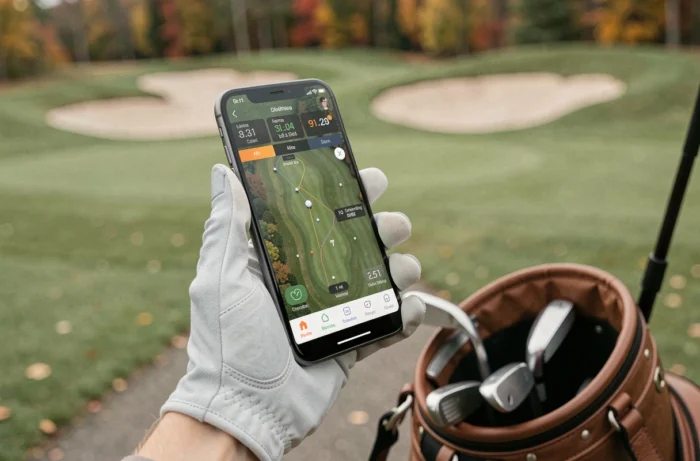
The embedded GPS technology, like that of Chiping GPS Tracked Golf Balls, marketed as the first consumer GPS balls, takes a different approach. The chip communicates directly with a dedicated smartphone application to provide real-time positioning, without local infrastructure. This shift from RFID to GPS transforms the GPS-enabled golf ball into a portable accessory, usable on a course in France or abroad.
GPS Location on the Course: What the Traceable Ball Changes in Real Play
Ball loss remains one of the most common frustrations in golf. It slows down the game, increases the cost of consumables, and generates stress that distracts from subsequent shots.
Search Time and Game Pace
The rules of golf allow a limited time to search for a lost ball. With a GPS ball, the application displays a reduced search area directly on the phone screen. The player heads towards the indicated point instead of raking through the tall grass at random.
The gain is measurable on each hole where the ball leaves the fairway. Less time spent searching means a smoother pace of play for the player and for the groups that follow.
Lost Balls and Game Cost
An amateur golfer regularly loses balls on a course, especially on unfamiliar layouts or those bordered by dense vegetation. Finding these balls instead of replacing them reduces consumption over a season. The unit cost of a GPS ball compared to a standard ball can be offset if the loss rate decreases significantly.
Game Data Collected by the GPS Ball: Distance, Position, and Course Analysis
Beyond location, the GPS ball paired with its application can record useful data for training and course analysis.
- The actual distance traveled by each shot, measured between the strike point and the stopping point, without visual estimation or rangefinder
- The mapping of successive positions on the course, which allows for visualizing shot dispersion and identifying trends (recurring slice, short approaches)
- The history of rounds on different courses, stored in the application and accessible to prepare for a return to a previously played layout
This information complements what GPS watches and shot tracking systems provide, but with one difference: the data comes directly from the ball, not from a sensor fixed to the club or wrist. The distance measurement is therefore linked to the actual trajectory of the ball and not to an estimate based on the swing motion.
Golf Rules and Traceable Ball: What the Regulations Allow
The use of a distance measuring device during a competition depends on the local rules adopted by the organizing committee. The Rules of Golf clearly distinguish two functions.
The first is distance measurement, which is allowed by default since the revision of the rules. A player may use a device that calculates the distance between two points on the course.
The second concerns complementary functions such as measuring wind, elevation, or any aid in club selection. These functions remain prohibited in competition unless a local rule explicitly permits them.
For the GPS ball, the question revolves around the nature of the assistance provided. Locating a lost ball falls under visually assisted searching, not strict distance measurement. Checking the ball’s compliance with the committee before a competition remains the precaution to take. In friendly play, no restrictions apply.
Current Technical Limitations of GPS Golf Balls
The miniaturization of a GPS chip in an object subjected to repeated impacts poses constraints that manufacturers have not fully resolved.
- The lifespan of the chip is limited: current GPS balls are designed as consumables, not as permanent equipment. After a certain number of rounds, the chip may stop emitting
- The accuracy of the GPS signal depends on the environment. Under dense forest cover or in a deep valley, location reliability may decrease
- The addition of an electronic component to the core of the ball potentially alters its flight properties. OnCore Golf, which has been working for several years on a traceable ball with a chip integrated into the core, has acknowledged that protecting the component from shocks while maintaining the ball’s performance remains a major technical challenge
These constraints explain why the market is still limited to a few specialized manufacturers, far from premium ranges like Titleist Pro V1 or their RCT variants, which focus on capturing data via radar in indoor environments rather than on outdoor geolocation.
The GPS golf ball is aimed at players who prioritize practicality on the course and the analysis of their game data. The shift from a technology linked to a single club (RFID) to a portable accessory usable anywhere marks a concrete change in how to approach a round, especially for golfers who regularly discover new layouts.