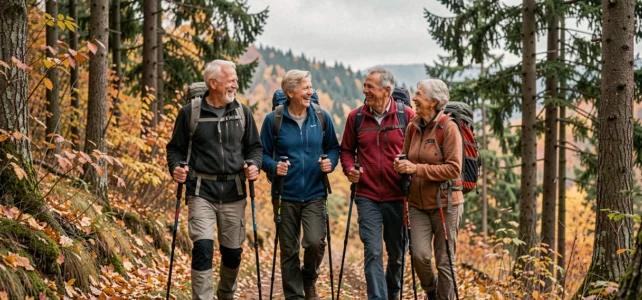
Walking side by side for two hours creates a closeness that dating apps struggle to replicate. The gaze is directed at the path, conversation starts without pressure, and the pace of walking naturally filters affinities. Hiking for single seniors exploits this simple mechanism: replacing the screen with a trail, the online profile with a real conversation outdoors.
Online pre-contact before the outing: what changes the group dynamic
Have you ever felt that awkwardness when arriving alone in a group where everyone seems to know each other? Organizers of singles outings have understood this. Some platforms now allow you to discover the registered participants before the departure and exchange a few messages in advance.
This pre-contact reduces the “first date” effect on the ground. When you arrive at the starting point, you’ve already spotted two or three faces, read a few introductions. The conversation picks up where it left off online, without the awkwardness of formal introductions.
Participating in hikes for single seniors then takes on a different dimension: you join a group that is already warm, not a gathering of complete strangers. The walking does the rest.
Walking pace and elevation: the real compatibility criteria in senior hiking
The choice of an outing does not rely on the beauty of the landscape displayed in the brochure. The walking pace acts as a compatibility filter much more reliable than age or declared interests.
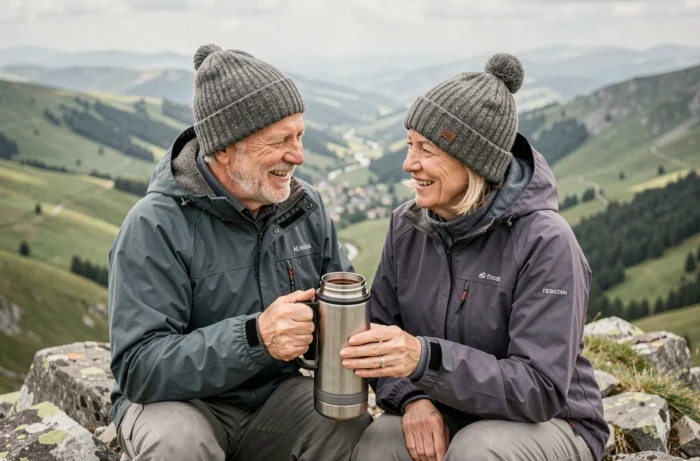
Someone who is out of breath after twenty minutes will not walk alongside someone who covers the miles. Conversations arise between walkers at the same tempo. Serious organizers have integrated this: they now ask participants to specify their walking ability before registration, not just their status or age group.
What short formats bring to the first outings
For a first experience, short routes with moderate elevation work better. They leave enough time to chat without turning the outing into a physical trial. A hike that is too long tires participants and cuts off exchanges in the last third of the route.
The most suitable formats combine several concrete criteria:
- A limited duration, generally between two and three hours, to maintain the energy and good mood of the group until the end
- A capped number of participants (some organizers limit it to about twenty people) to encourage individual exchanges rather than a crowd effect
- A balanced male/female ratio announced at registration, which avoids frustrating imbalances seen in events open to all
These criteria may seem basic, but they distinguish an outing designed for meeting from a simple group walk.
Safety and autonomy in the mountains after 60
Friendliness does not exempt from caution. Official recommendations are clear: do not hike alone, inform a loved one of your itinerary, check local conditions before departure. These rules apply even more to seniors who are resuming walking after a long break.
Why is this point so rarely addressed in singles hiking offers? Because the marketing discourse emphasizes meeting, not risks. Proper supervision protects both safety and the quality of the experience.
What a good organizer checks before departure
A reliable organizer does not just set a place and time. They anticipate logistics: water points along the route, network coverage in case of emergency, weather backup plan. These details change everything for a senior audience that may not necessarily be used to hiking independently.
Group hiking with supervision offers a concrete advantage: if a participant slows down or feels unwell, the group adapts. This is the opposite of a solo outing where a minor issue (blister, fatigue, disorientation) can quickly become stressful.
Organized trips or local outings: two approaches that do not meet the same need
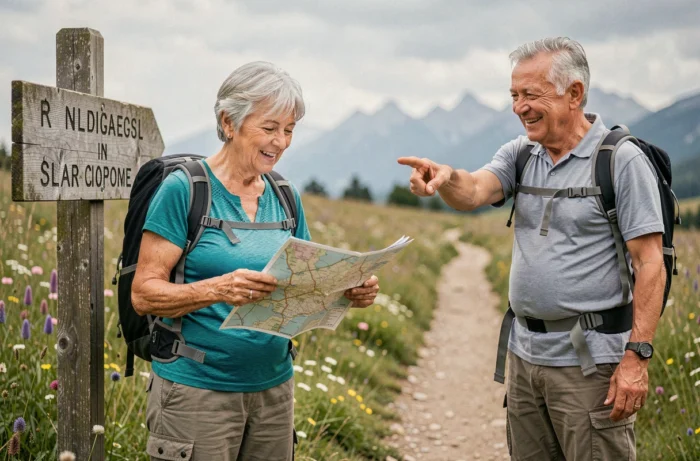
Organized trips for single seniors and day outings do not target the same profile. The local outing tests compatibility without financial commitment or heavy logistics. You book a Sunday morning, you walk, you see if the format suits you.
The multi-day trip, on the other hand, implies a more engaging decision. It is suitable for people already comfortable with the concept and who wish to deepen connections over time. Spending a week in a group creates an intimacy that three hours of walking cannot provide.
The common pitfall is to start with an expensive trip before testing a simple outing. Here is a logical progression:
- Start with a local walk of a few hours, without overnight stay, to assess comfort in the group
- Follow up with one or two additional outings to see the same faces and engage in real conversations
- Consider an organized trip only after identifying the type of group and pace that suits
This progression avoids disappointments. It also allows you to distinguish serious organizers from purely commercial offers that pile up participants without caring about group dynamics.
French regions and outing formats for single seniors
Outings exist in Île-de-France, Lyon, and several regions where demand is structuring. Routes in state forests or along waterways attract a senior audience looking for flat or low elevation, far from challenging mountain trails.
The format is also evolving. Some local associations combine walking with a convivial moment at the end of the route: shared picnic, terrace break, site visit. This post-walk time extends exchanges and provides a more relaxed setting to deepen a conversation started on the trail.
Hiking for single seniors does not need extraordinary promises to work. A well-calibrated route, a balanced group, attentive supervision, and a pace that allows for conversation are enough. The rest belongs to the walkers.