
A swimsuit bottom that absorbs menstrual flow without swelling in water, without visible leaks, and that resists both chlorine and salt: the promise seems simple, but its realization requires very specialized textile skills. Designing an innovative menstrual swimsuit means solving an equation where each layer of fabric must fulfill a specific role under aquatic constraints.
Hydrostatic pressure and thin membrane: the constraint that the specifications must integrate from the start
When designing a classic swimsuit, the only real technical requirement concerns resistance to chlorine and UV rays. For a menstrual swimsuit, an additional variable is introduced that few designers anticipate correctly: hydrostatic pressure.
Water exerts pressure on the submerged body, and this pressure compresses the fabric in the crotch area against the skin. In practice, the water pressure limits the outgoing flow and allows for the use of thinner absorbent layers than a traditional menstrual panty. This is an advantage, provided it has been integrated into the specifications from the prototyping phase.
The waterproof membrane, placed between the absorbent layer and the outer fabric, must remain sufficiently flexible to avoid creating a rigid effect when worn. Next-generation membranes are thinner and less rigid than those used a few years ago.
The entire challenge of initial sourcing lies in this compromise: a membrane that is too thick swells in water, while a membrane that is too thin risks giving way under swimming movements.
The technical details related to the creation of a menstrual swimsuit can be found in the material selection steps, which condition the rest of the process.
Textile sourcing: recycled nylon, certifications, and chlorine resistance
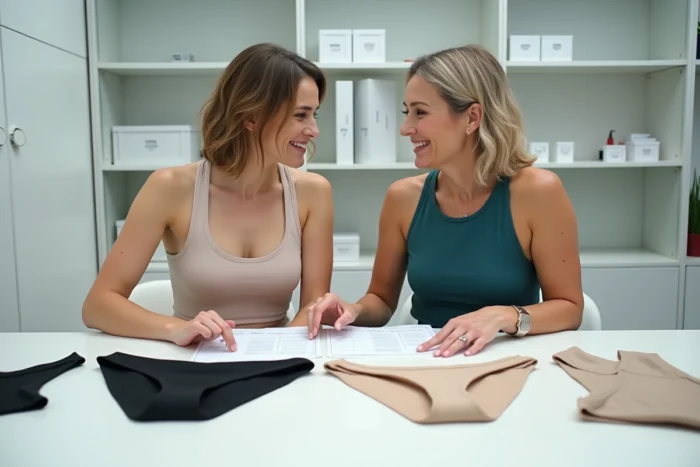
The choice of textiles is not trivial. The current trend pushes brands towards recycled fibers (nylon, polyester), but an eco-certified fabric does not automatically suit menstrual use in aquatic environments. Two criteria filter out the majority of references available on the market.
- Chlorine and salinity resistance: the fibers must retain their structure after dozens of washes and exposures to pool or seawater, without the absorbent layer losing its drainage capacity.
- Compatibility with thin waterproof membranes: some recycled fabrics have a weave that is too loose to be assembled with a membrane without the risk of delamination after a few uses.
- Drying time: a menstrual swimsuit that takes too long to dry between swims becomes unusable in real situations, especially during a full day at the beach.
Selecting a chlorine-resistant recycled fabric that is compatible with a thin membrane represents the real bottleneck of sourcing. Feedback on this point varies among suppliers, and it often requires ordering several samples before validating a material.
Assembly of absorbent layers: prototyping and field tests
A menstrual swimsuit functions through the assembly of three distinct layers, each with a specific role. The draining layer, in direct contact with the skin, directs the flow to the central absorbent layer. This layer retains blood without swelling when in contact with water. The outer waterproof membrane prevents any leaks to the visible fabric of the swimsuit.
Each layer must be tested separately and then in complete assembly before validating a prototype. One cannot rely solely on the technical sheets from suppliers: a draining fabric that performs well on paper can saturate too quickly if the absorbent layer underneath does not keep up.
Prototyping involves testing under real conditions. This means trials in a pool (chlorinated water) and in the sea (salty water), over several hours, with varying flow levels. Brands that have made a mark in the market, such as Réjeanne, have co-developed their products with their community of customers, gathering extensive usage feedback before launching production.
Design and pattern of menstrual swimsuit: balancing absorption and silhouette
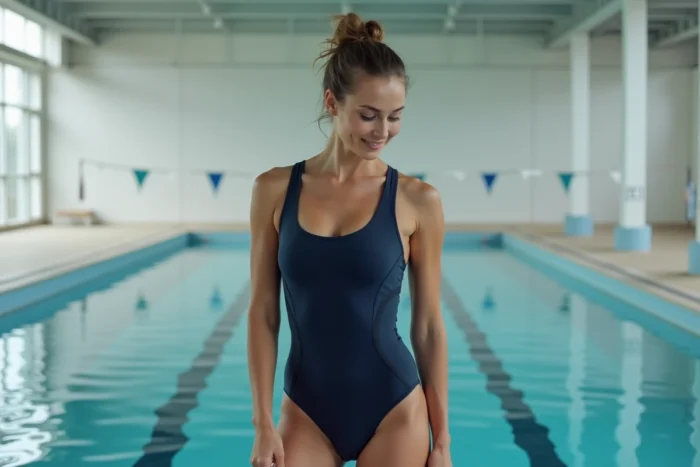
A menstrual swimsuit that works perfectly but looks like a diaper has no commercial chance. The design must render the technical area invisible while ensuring sufficient support for the layers to stay in place during swimming.
The pattern of a menstrual swimsuit bottom differs from a classic bottom in two ways. The crotch area is wider to accommodate the absorbent layers without creating visible folds. The seams in this area must be flat and durable, as they undergo mechanical stresses greater than those of an ordinary swimsuit.
Aesthetically, current models come in one-piece or bikini bottoms. The choice of model directly influences the available absorbent surface and thus the capacity of the swimsuit. A one-piece offers more latitude to extend the technical area, while a bikini bottom requires more extensive miniaturization work.
Product validation and compliance before market launch
Before launching production, two things are checked. First, textile compliance: the materials in contact with mucous membranes must meet current health standards, and the absence of harmful substances must be certified by independent laboratories. Then, durability: a reusable menstrual swimsuit must retain its absorbent and waterproof properties after a significant number of washes.
Durability tests focus on the number of wash cycles before measurable degradation of absorption, the integrity of seams after prolonged exposure to chlorine, and the dimensional stability of the swimsuit (no deformation). These data condition the maintenance recommendations communicated to customers.
The final quality of the product depends on the rigor applied at each upstream stage. An innovative menstrual swimsuit is not the one that stacks the most layers, but the one whose every component has been selected, tested, and validated to function in a real aquatic environment over time.