
A burglarized warehouse rarely has the main gate lock that has failed. In most cases, the intrusion occurs through a poorly equipped secondary exit, an open loading dock, or a duplicate key that circulates without traceability. Securing a warehouse requires thinking in terms of flows, zones, and access levels, not just hardware. Here are ten concrete actions to lock down your professional premises.
1. Map out logistical flows before choosing a lock

We often think of locks starting from the product catalog. On the ground, the first question is different: where do people, carts, and goods flow? The receiving-shipping areas, pedestrian corridors, and vehicle access points have different constraints.
A high-end lock installed on a door that blocks a flow of carts will be circumvented constantly (door propped open, cylinder forced by wear). Adapting the locking system to actual traffic avoids this type of drift. To delve deeper into this topic, several locksmithing tips for warehouses detail this flow-based approach.
2. Segment access by zone with distinct rights
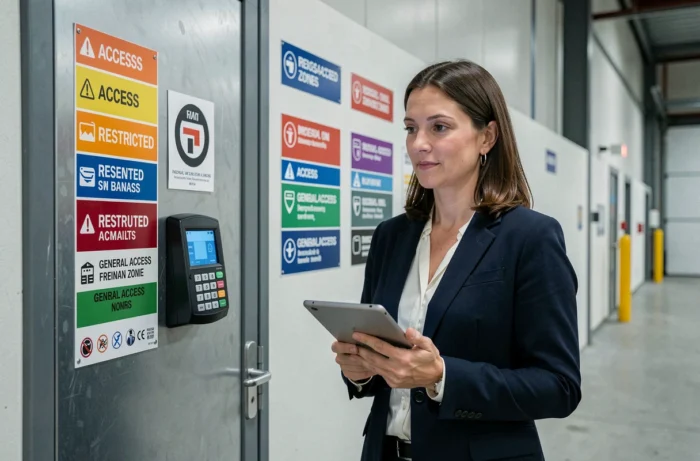
A warehouse is not a single volume. It contains a reception area, administrative offices, storage rooms, and sometimes a server room or archives. Each zone deserves its own level of control.
Fine segmentation of access involves assigning different rights based on profiles: the delivery person accesses the loading dock, not the offices. The maintenance technician enters the technical room, not the sensitive goods storage. Distinct access rights by zone reduce the exposure area in case of a lost badge or compromised code.
3. Install A2P certified multipoint locks on main access points
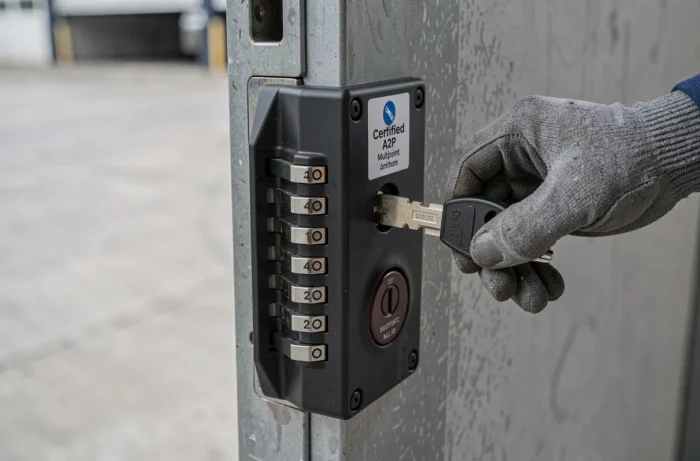
The A2P certification guarantees that a lock has undergone resistance tests against picking, drilling, and pulling. In a warehouse, the main entrance and service doors are the primary targets. A multipoint lock (three, five, or seven locking points) distributes pressure along the entire height of the door leaf.
The number of points required depends on the height and weight of the door. On a large industrial metal door, five points are a minimum operational requirement. Feedback varies on this point depending on the type of frame, hence the usefulness of an on-site diagnosis.
4. Secure secondary exits and loading docks
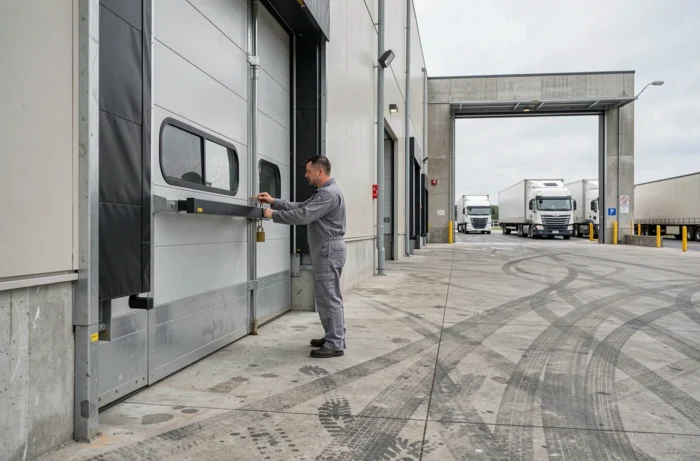
The majority of break-ins in warehouses exploit a back door, an emergency exit, or a loading dock curtain. These access points are less monitored and often equipped with low-quality locks.
It is recommended to equip each secondary exit with a reinforced mechanical locking system (panic bar with European cylinder lock) and to ensure that the metal curtains of the docks have a ground lock. An unlocked dock can be lifted in seconds with a simple crowbar.
5. Implement an electronic access control system with logging

The badge, code, or biometrics do not replace the lock; they complement it. The advantage of electronic access control is traceability: you know who passed through, at what time, and by which door.
For a warehouse, the system must allow for regular updates of badges and codes. When a temporary worker completes their assignment or a contractor finishes their job, their access must be disabled the same day. A system without logging is like installing a lock without knowing who holds the keys.
6. Control the reproduction of physical keys
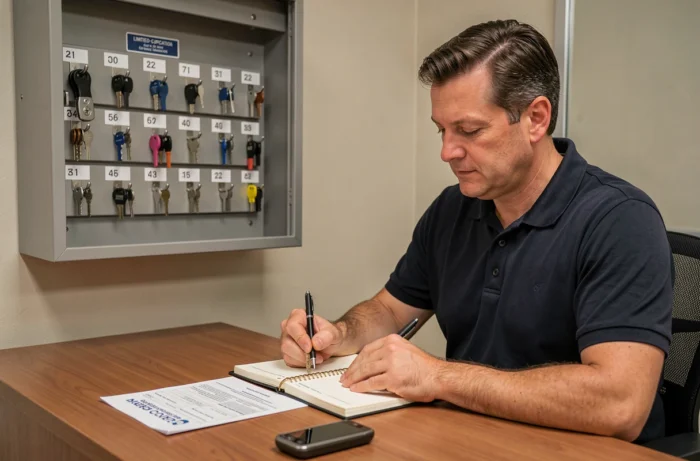
Securing a lock is not enough if too many duplicates are circulating. On a site with about ten employees and regular contractors, the number of copies can become uncontrollable within a few months.
The solution: opt for patented key cylinders. Reproduction then requires the ownership card of the cylinder, which blocks any unauthorized copies. A register of assigned keys is maintained with the date and name of the holder. An up-to-date key register is as valuable as a good lock.
7. Reinforce the doors themselves, not just the locks
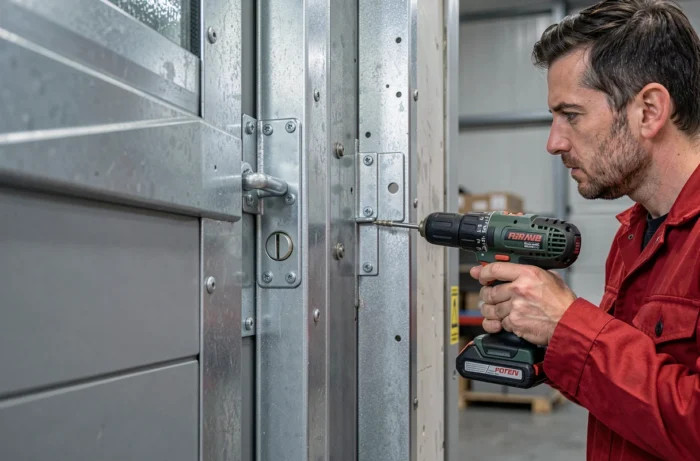
An A2P lock on a thin sheet metal door is like a lock on a cardboard box. The frame, the door leaf, and the hinges must be consistent with the level of the lock.
In a warehouse, steel doors with anti-removal corners offer suitable mechanical resistance. Points to check include:
- The thickness of the door leaf (too thin steel can be cut quickly)
- The fixing of the frame in the masonry (chemical anchors on hollow blocks)
- The presence of anti-removal corners on the hinge side
8. Combine locks and anti-intrusion alarm systems
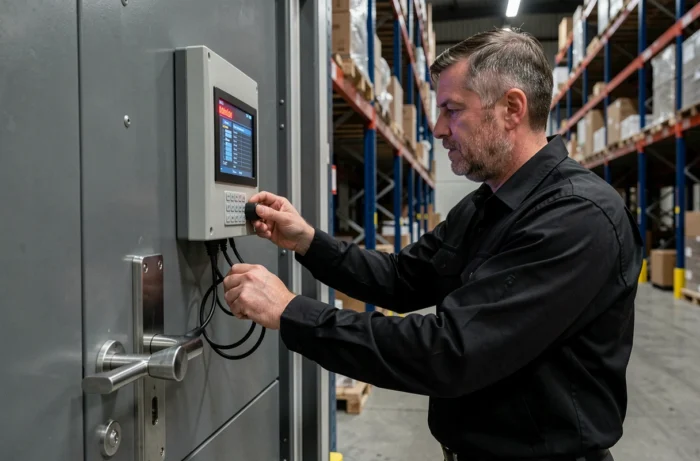
The lock delays the intruder, the alarm signals it. The two work together. A perimeter detection system (sensors on openings, volumetric detectors in storage areas) triggers an alert as soon as a door is forced.
Remote monitoring adds a layer of response: an operator verifies the alert and initiates intervention. Without an alarm, a lock resists for a few minutes in silence. With an alarm, those few minutes become a countdown for the intruder.
9. Plan preventive maintenance for industrial locks
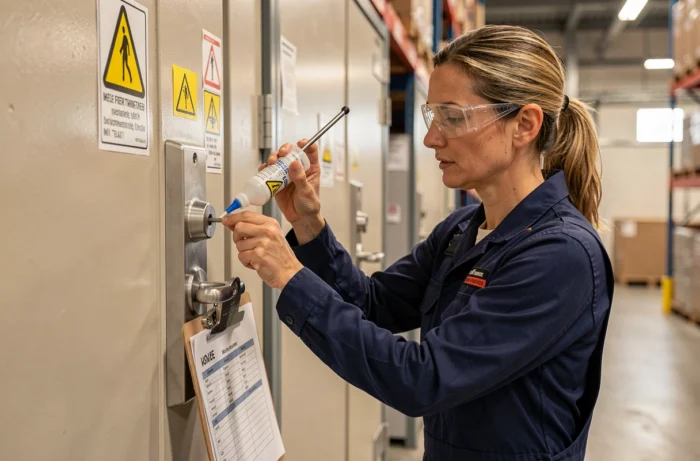
A jammed cylinder means an employee forcing the key, a broken cylinder, and a door stuck open while waiting for repairs. Preventive maintenance reduces breakdowns and emergency intervention costs.
A semi-annual check of cylinders, strikes, and door closers is scheduled. Lubricating mechanisms, checking the alignment of the bolts, and replacing worn parts prevent failure at the worst moment. In an active logistics site, a non-functioning door disrupts the entire chain.
10. Conduct a structured security audit before any investment
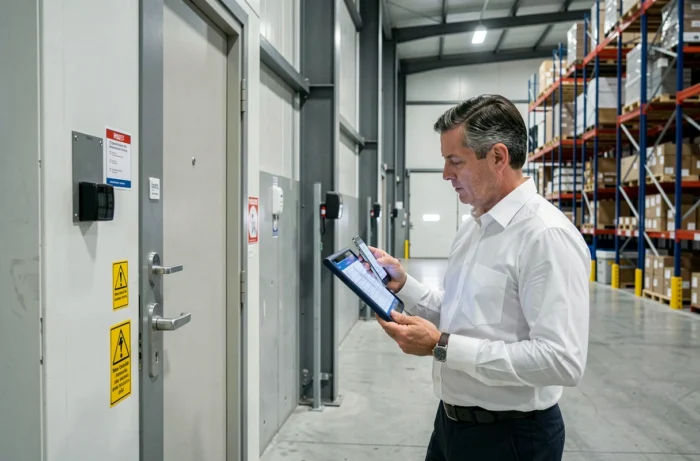
Before ordering locks or an alarm system, a structured audit allows for prioritizing investments. Recent audits follow a phased sequence: document analysis (plans, incident history), on-site inspection, technical tests on existing openings, and then organizational audit (key management procedures, personnel rotation).
The result is a prioritized action plan that distinguishes emergencies (loading dock door without locking) from improvements to plan (migration to an electronic access control system). This approach avoids spending on high-performance equipment where the risk is low, while leaving a gaping hole elsewhere.
Warehouse locking systems are not just about choosing a cylinder. It is a set of decisions that touch on flows, human procedures, and the coherence between the door, the lock, and the detection system. The starting point remains the same: observe the ground before opening a catalog.